Showing posts with label John Scott Keltie. Show all posts

Sunday, 17 September 2023

RGS 125th Anniversary Dinner - 1955

There was a strong representation of former GA Presidents at this event, held at the Dorchester Hotel - very posh.

In the speech that followed, the GA gets a mention, alongside the previous explorations and expeditions.


There is also a mention for recent Medallists, including Sir John Russell (another former GA President)


“The 125th Anniversary Dinner.” The Geographical Journal, vol. 121, no. 3, 1955, pp. 392–404. JSTOR, http://www.jstor.org/stable/1790929. Accessed 16 Sept. 2023.

Wednesday, 1 January 2020

1953: Dr Osbert John Radclyffe Howarth, OBE

Updated October 2023

Dr. Osbert J R Howarth was a curator of Down House (the former home of Charles Darwin), for English Heritage.
He was Secretary of the British Association, 1909-1946 and wrote a centenary history of the association in this capacity.

When I started researching Dr Howarth, there wasn't a lot of information on him to be found at all, and this still remains one of the more scant entries on the blog even after my researches. It has thankfully grown over time.

W.G.V Balchin's centenary book mentioned him in a brief few lines shown below:

Born 1877- Died: 1954. Westminster and Christ Church, Oxford. History degree and Geography diploma.
1904-1911 Geographical assistant to the editor of Encyclopaedia Brittanica.


He was linked with the British Association for the Advancement of Science, for whom he was Secretary from 1909 to 1946.
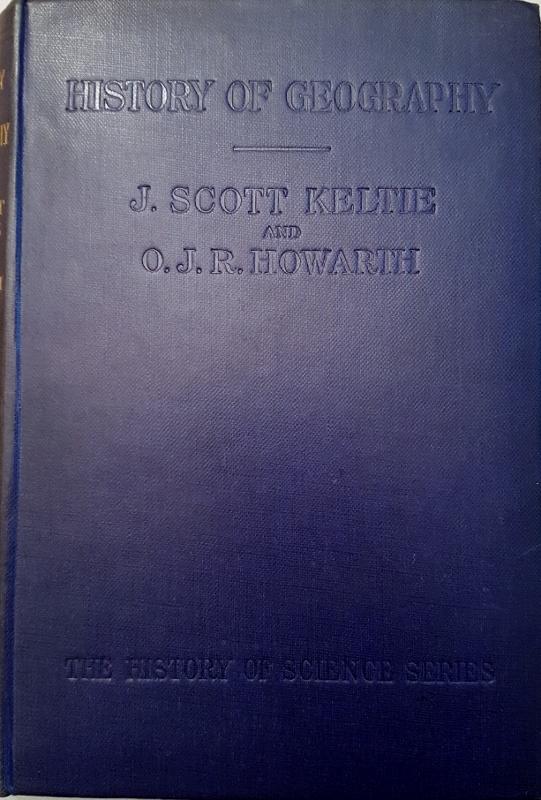
He co-wrote a history of Geography with fellow President John Scott Keltie, see references. This would have been a significant work at the time.

He wrote and edited numerous Geographical books for Oxford University Press, including 'A Geography of Ireland'. He co-wrote a book on the British Empire with fellow President A J Herbertson.

He was a great advocate of the Commonwealth replacing the Empire.

He even chose this theme for his Presidential Address, which was called "The Commonwealth in the Geography Syllabus".

"The British Association: A Retrospect" by O J R Howarth. The first edition, published in 1922 covers the years 1831-1922; a second edition published to coincide with the British Science Association’s centenary in 1931 covers the hundred years from 1831-1931.

He had a life long interest in the GA, but sadly died in 1954, just after completing his Presidential term.
This is described in this report on the following year's conference.

Some of his other publications:


Image result for O.J.R HowarthRelated image

His Presidential address was published in 1954 in 'Geography'.

I like his starting point about the positioning of the address within the President's tenure, and the ability to speak freely. He then said that having never taught geography he was going to tell geography teachers what he thought they ought to be doing, particularly teaching about 'world citizenship' and range further afield rather than a focus on the UK as it had at the time, from Howarth's perspective. This is an interesting position from which to start as GA President of course, but not uncommon in the earlier years of the GA.


It seems that he did a good job as President, as reported in the Annual Report for 1953


He wrote a 'History of Geography' with John Scott Keltie. This was published in 1913 and is available to read from this link.

References

If anyone knows anything more about this President, or has images, please let me know. I am lacking a decent photograph of this President.

One copyrighted image is here.
https://artuk.org/discover/artworks/dr-o-j-r-howarth-18771954-194318 - Artist is Robert Darwin.


Howarth, O. J. R. “THE COMMONWEALTH IN THE GEOGRAPHY SYLLABUS. Address to the Geographical Association.” Geography, vol. 39, no. 1, 1954, pp. 5–13. JSTOR, www.jstor.org/stable/40564669

Howarth, O. J. R. (Osbert John Radcliffe), 1877-1954. The British Association for the Advancement of Science: a Retrospect 1831-1921. London: The Association , 1922.

https://www.thegazette.co.uk/London/issue/31840/supplement/3791/data.pdf
- according to this he connected with the Naval Intelligence Division of the Admiralty, and his son served with the Naval Reserve I think according to this source
https://www.unithistories.com/officers/RNVR_officersH2.html
which describes him as a "scholar in geography".

1922: Book on the Scope of School Geography - book on the Internet Archive site.

The Study of the Geographical Environment - book on the Internet archive site.

https://openlibrary.org/books/OL7178190M/The_British_association_for_the_advancement_of_science
http://www.aughty.org/pdf/historical_geog_irl.pdf

A book called "History of Geography" was written with John Scott Keltie and published in 1913. It can be read on the Internet Archive site.


http://www.gutenberg.org/files/58349/58349-h/58349-h.htm - readable Project Gutenberg book which explores the 'history of geography"...

I contacted the British Association for the Advancement of Science to see whether they had an image, or more information on this President.
I'm still waiting for a response at the time of posting. Actually still waiting over two years later.

Update - this book was co-written with two others, including a familiar name in R N Rudmose Brown.


Readable on the Internet Archive and quite useful...

Updated August 2021
National Portrait Gallery photo.

Updated October 2023


He's on here somewhere then...


The Archives of Down House and BAAS have letters from Howarth in them, as does the Bodleian Library.

I discovered in an issue of the Elizabethan the confirmation that he went to Westminster School, followed by Oxford University.  This makes him an Old Westminster.

https://elizabethan.westminster.org.uk/Filename.ashx?tableName=ta_elizabethan&columnName=filename&recordId=609

The extra information about him being involved with the production of the geography section of Encyclopaedia Brittanica was also really interesting. Another avenue to explore...


The magazine also had information on his wedding.


Thursday, 1 August 2019

1927: Colonel Sir Charles Close KBE CB CMG FRS (later Arden Close)


Updated August 2023


Colonel Charles Close was a Geographer and Surveyor, and the GA had somebody as President, for the first time in a while, who could be said to be a Geographer both at heart, and in occupation.

Charles (Arden) Close served as Director General of the Ordnance Survey from 1911 to 1922.

(10 August 1865 – 19 December 1952) 

There are several biographies of him online, which provide plenty more detail on his achievements, and the way that he prepared the OS for the demands of the First World War, which were particular impressive and showed his attention to detail:
Biography here.
A detailed biography here (PDF download)

Amongst the offices which he held were those of President of the International Union of Geography from 1934 to 1938, President of Section E (geography) of the British Association in 1911, President of the Geographical Association in 1927, President of the Royal Geographical Society, 1927 to 1930 (he was also on the RGS Council for 35 years) and was also Chairman of the Palestine Exploration Fund for fifteen years. He was Honorary Secretary of the International Geographical Congress.

This link to the RGS is also something which has been very important over the years, and Close seems to have been linked more closely with them than the GA.

Following text is from his Wikipedia page (shared under CC license)

Colonel Sir Charles Frederick Arden-Close, was a British geographer. He was Director General of the Ordnance Survey from 1911 to 1922. His insistence on attention to detail saw the improvement of many attitudes and methods at the Ordnance Survey. Close's planning saw the production of many maps now viewed as pinnacles in the classic period of map making. 

He was born Charles Frederick Close and changed his surname to Arden-Close in 1938 so as to comply with a bequest.

He was born in Jersey, the eldest of the eleven children of Major-General Frederick Close (1830–1899) After receiving his commission in the Royal Engineers in 1884, he saw service in the School of Military Engineering, and served in Gibraltar and India.

In 1889 Close was posted to the survey of India where he carried out topographic work in Burma and triangulation in Mandalay. There was a further posting to eastern Nigeria, to survey the border with the German Cameroon. After appointment to the Ordnance Survey he carried out much work in central, eastern and southern Africa. Close led a small surveying unit in the Second Boer War, and returned to Chatham in 1902 to become chief instructor of surveying at the School of Military Engineering. His Text Book of Topographical and Geographical Surveying, published in 1905 became the standard textbook on the subject.

Close served as Head of MO4, the Geographical Section of the General Staff, at the War Office until 1911.

In 1911, he was appointed Director General of the Ordnance Survey, a post he held until 1922.
He introduced more rigorous scientific methods at the Ordnance Survey and proceeded with a second levelling of the United Kingdom. He was intent on producing one-inch maps of revolutionary appearance, including colour printing and precise printing methods. Because of the high cost of production Close had to compromise his aims and a simpler style was adopted.
This design set the standard for subsequent one-inch series.

Charles Close married in 1913 and had two sons and a daughter. He was knighted in 1918, in recognition of the Ordnance Survey's efforts during World War I during which over 30 million maps were produced.
He was elected a Fellow of the Royal Society in 1919.
Upon retirement in 1922 he became secretary of the International Geographical Congress and was also a long-serving Fellow of the RGS and in 1927 was awarded their Victoria Gold Medal and was later elected President (1927–30).

The announcement of his appointment in the Geographical Teacher:


In the same year, he became the President of the GA, Close became the first person to write an article in the newly named journal 'Geography' journal - the name change was mentioned in a recent blog post.
He described the different types of people who go to Geography conferences in his address on Population and Migration.

Which one are you?

Close continued to support the GA following his Presidential year, which was described as a great success by all accounts.

"Geography untouched by the human hand is dull to an extraordinary degree"
Sir Charles Close, Royal Geographical Society, 1932

The Annual Report of 1928 mentioned his ongoing support for the Association.

The Charles Close Society is still in operation, and is for those who are interested in Ordnance Survey Maps.
Thanks to John Davies with whom I corresponded about Charles Close, and Elaine Owen of the OS for her input and suggestions.


Close died in Winchester in 1952.

1927 also saw a few other events.
First was the death of Sir John Keltie.
1927 also saw an experiment in publications beyond the journals. Two research publications were created: one on a Historical Geography of Ireland and one on the Deccan Plateau, but sales were poor.

There is an interesting connection between Charles Close and my current work with the Ordnance Survey's GetOutside Campaign.

References

Wikipedia: https://en.wikipedia.org/wiki/Charles_Close - source of some of the page above

I added his GA Presidency role to the page.

OS website: https://www.ordnancesurvey.co.uk/docs/ebooks/map-makers-to-britain-since-1791.pdf (PDF download)

There is a Charles Close Society for the study of OS Maps which shows his influence persists even now.

Fleure, H. J. “ANNUAL REPORT.” Geography, vol. 14, no. 4, 1928, pp. 338–341. JSTOR, www.jstor.org/stable/40558279.

If anyone knows anything more about Charles Close and his work with the GA, please get in touch.

Update November 2019
Charles Close collaborated with the famous illustrator Ellis Martin.
He launched the One Inch Map for Tourists which sold well.


Update December 2019

Charles Close's obituary was published in 'Geography', written by H. J. Fleure.


Updated July 2022
A good quote:


Updated August 2023

A few tweaks and amendments and additional labels added.

I looked at the development of the International Population Union - linked with the UN - Close was the President for 6 years - was that of the UK National congress of the IPU?

A M Carr Saunders (another former GA President) mentioned it in an article in Nature:

Source:
International Population Congress in Paris. Nature 140, 471 (1937). https://doi.org/10.1038/140471a0

I also followed up some more on the MO4 - the Geographical arm of the War Office, or the Military Survey.


Source:

Updated August 2023

Close was not always as strong a supporter of 'geography' as he was when President (presumably).
In 1911, he was at a meeting of BAAS Section E.
This was linked to the changed nature of the papers presented, partly down to former GA Presidents who said that listening to travel papers wasn't necessarily advancing the discipline....


The outcome was:


Source:

Charles W. J. Withers, et al. “Geography’s Other Histories? Geography and Science in the British Association for the Advancement of Science, 1831-c.1933.” Transactions of the Institute of British Geographers, vol. 31, no. 4, 2006, pp. 433–51. JSTOR, http://www.jstor.org/stable/4639988. Accessed 24 Aug. 2023.

Beaver, S. H. “Geography in the British Association for the Advancement of Science.” The Geographical Journal, vol. 148, no. 2, 1982, pp. 173–81. JSTOR, https://doi.org/10.2307/633769. Accessed 24 Aug. 2023.


Thursday, 11 July 2019

Magic Lantern Slides

One of the facts that is often quoted about the formation of the Geographical Association's origins is that is was founded in part because of the desire for teachers to share resources in the form of lantern slides, which were accompanied by lesson materials. The GA worked with a company called the Diagram Company, which started by loaning slides, and moved on to selling them. I have a few lantern slides, which are not of any great age, and there used to be a large selection down in the warehouse at Solly Street for a while. Some of these were donated by Presidents, such as Vaughan Cornish, and others. H J Fleure and his assistant in the library also used to coordinate the loan of these slides from Aberystwyth (see Fleure's entry for more details)
A later blog post will outline some of the work that this company did, and influences on Pedagogy.

There are some connections here with the Royal Geographical Society once again, of course, as they also have a large collection of lantern slides.
Emily Hayes has been researching the different views on the use of magic lantern slides, which mirror some of the debates currently being had around the use of traditional and progressive pedagogies.

I am grateful to Emily for sending me a copy of her paper, which made good reading. The events here predate the blog largely, as they took place in the run up to the formation of the Association in 1893, but the role of the RGS is mentioned.


The role of women within the RGS was significant of course, as previous blog posts have outlined.

Emily's thesis broadens out the use of lantern slides into the 1920s, but from the title and synopsis focusses on the role of the RGS rather than the Geographical Association.
The chapters below explore how these innovations in visual technologies and practices arose, how they circulated knowledge and their effect on geographies of geographical knowledge making. By harnessing the lantern the RGS attracted an expanding and diversifying audience demographic. The thesis demonstrates the interactive nature of RGS lantern-slide lectures and audiences' important role in shaping the Society’s practices and geographical knowledge. The chapters below argue that it was via the use of the lantern that geography was disseminated to new places. The thesis therefore brings additional perspectives and dimensions to understandings of the circulation of geographical knowledge.
Read more at https://ore.exeter.ac.uk/repository/handle/10871/23096#PSdvQPc7baSCXDiL.99


I read about the way that slides turned some lectures into a type of 'performance', the forerunner to the Powerpoint driven sessions that many of us will have given, or sat through.


COVIC is the Colonial Office Visual Instruction Committee. It was set up in 1902, and lasted through the First World War. Mackinder was associated with its work.


As Emily goes on to say:

"The Map Room accepted lantern-slide donations from 1888. 543 Donations increased from 1892-93 when the GA was founded.  The Society advertised the fact that it was seeking to acquire lantern-slides in the Year Books throughout the late 1890s. From 1918 Fellows or their executors, family and friends offered the sale of lantern-slide collections to the RGS."

When following up on this, I came across reference to an article by Professor Joan Schwarz, which sounded like it might be useful. I contacted Joan, who works at the Queens University in Ontario, Canada and she kindly sent me a copy of the article, and showed interest in the blog project.
More on this to come in a future blog post.


References
Emily Hayes: 'Geographical light: the magic lantern, the reform of the Royal Geographical Society and the professionalisation of geography c.1885-1894
https://www.sciencedirect.com/science/article/pii/S0305748817300427

Thesis:
https://ore.exeter.ac.uk/repository/handle/10871/23096

Fleure, H. J. “SIXTY YEARS OF GEOGRAPHY AND EDUCATION. A RETROSPECT OF THE GEOGRAPHICAL ASSOCIATION.” Geography, vol. 38, no. 4, 1953, pp. 231–264. JSTOR, www.jstor.org/stable/40564702.

C. Herbert, Culture and Anomie: Ethnographic Imagination In The Nineteenth Century, University of Chicago Press, 1991, 153-54 and 262-5; Driver, Geography Militant; and Withers, Science, scientific instruments and questions of method in nineteenth-century British geography, 167-179.

Ryan 'On visual Instruction' in
The Nineteenth-century Visual Culture Reader

https://books.google.co.uk/books?id=JAuPcgxiT0QC&lpg=PA149&ots=1Klyeu0FxB&dq=canadian%20high%20commission%20COVIC&pg=PA145#v=onepage&q=canadian%20high%20commission%20COVIC&f=false

MACKINDER, H. J. “THE TEACHING OF GEOGRAPHY FROM AN IMPERIAL POINT OF VIEW, AND THE USE WHICH COULD AND SHOULD BE MADE OF VISUAL INSTRUCTION.” The Geographical Teacher, vol. 6, no. 2, 1911, pp. 79–86. JSTOR, www.jstor.org/stable/40554112

Image: Lantern Slide from my collection, image CC licensed by Alan Parkinson

Update
You can buy a postcard set of lantern slide images from the GA shop.


Wednesday, 15 May 2019

1914: Dr John Scott Keltie (later Sir) FRGS FSS

'We speak of geography not as a barren catalogue of names and facts, but as a science that ought to be taught in a liberal way, with abundant appliances of maps, models and illustrations... 
We look to the Universities, not only to rescue geography from being badly taught in the schools of England, but to raise it to an even higher standard than it has yet attained'
J.S. Keltie, 1871 - RGS

Last updated November 2023

John Scott Keltie is someone whose name is well known beyond the sphere of Geography, and also had a strong connection with the Royal Geographical Society as well as being President of the Association for a year, at the start of the First World War. He was a fierce advocate for Geography.

He was another person involved in this period of change in the Association when the plan was to bring in distinguished outsiders with geographic interests to strengthen the standing of the Association.

Keltie was the author of the Keltie Report on education. This was a 150 page report which Keltie had been asked to produce 30 years earlier.
This explored the education system: assessment, curriculum and other aspects, and was influential in bringing about some changes. It was complimentary of the work being done at elementary level, but not as much about the work of secondary geographers. Keltie visited schools in a number of European countries as well as a range of schools across the UK when compiling his report, which Rex Walford's book provides more detail on.

This document from a Times obituary provides more details on the impact of the report:

His comprehensive report, the result in large part of personal investigation in many European counties and the United States, was the basis of that continuous action on the part of the society which has produced such valuable results. Geography, no longer despised among us, has now a sure footing in the schools at Oxford and Cambridge, where the diplomas are coveted, and the subject has a place in the degree examinations. 
Even the Colonial Office now requires from its officials in remote regions a knowledge of map-making. There are lectures in nearly all the English and Scottish universities. In the elementary schools the subject has made vast process from the repellent and useless geography taught some 40 years ago, while it is now a recognised place in many of the secondary schools. Text-books, maps and appliances of all kinds have been improved, and practical work in the field is common in many schools. 
In this movement Keltie played a constant and prominent part, as also in the gradual introduction into this country from Germany of the modern conception of geography, which no longer confined to an arid knowledge of the position of towns, rivers, and capes, has become a science dealing with the earth's surace as the physical basis of all human activity. In "Applied Geography," first published in 1890, he dealt usefully with this subject of anthropogeography, which he had urged and expounded in magazine articles for many previous years.

Keltie was born in 1840 in Dundee, and went to school in Perth, before studying at the Universities of St Andrews and Edinburgh, and completing some studies.
In the 1870s he became the editor of 'Nature': which remains an influential journal today.

In 1883, he joined the RGS, and became heavily involved in its activities. When he became GA President, he was also the Secretary of the RGS.

Malcolm Wise delivered an address to the GA and RGS in 1986, when he talked about the legacy of Keltie. There is a link below to the full text of what he had to say about Keltie's time in position (and before)

During Keltie's Presidency, membership grew to over 1100, despite the start of the First World War. The impacts of the War became more pronounced the longer it lasted, and the next few entries on the blog will mention some of these impacts. The GA during Wartime would be a suitable subject for a blog of its own I'm sure.

From the Archives hub page, I learned that Keltie was also at the start of the GA's Journal offerings, which remain so important today:
The new monthly Geographical Journal appeared in 1893 and was under Keltie's editorship until 1915, and joint editorship until 1917.
He resigned as secretary of the Royal Geographical Society in 1915, was elected to the council in 1917 and became vice-president of the society in 1921. He was knighted in 1918 and died in London in 1927.

His Presidential address was called 'Thirty years' progress in Geographical education' and reflected on the work since the 1880s, partly improved by the impact of his own report.


This piece makes interesting reading. Keltie starts by saying that now that the GA is in it's 21st year, it has perhaps come of age. He mentions a Mr. Rooper (who I need to find out more about) who apparently suggested the creation of the journal 'The Geographical Teacher' and helped to fund it.

He paid tribute to Douglas Freshfield, Halford Mackinder and Professor Garwood (who all get their own entries), and described the thousands of pounds the RGS had paid to help subsidise the new Geography courses that were appearing in part due to the influence of the GA and its officers. He talked about the rise of textbooks and other media to help teachers improve their practice over the previous thirty years. There was still work to do at this point, as not all universities recognised Geography as an honours subject.

He also provided some useful comments for those entering the 2019 Young Geographer of the Year competition, to a degree. I think I would add the word NOT to the sentence below... ie. 'NOT of value':

"Geography has a much greater commercial value now than it had thirty years ago. Most young men and many young women, have got their living to make, and there are a limited number of posts in which a sound knowledge of geography is of value, and these not merely in the teaching profession..."

He describes the decision made in 1905, when the Board of Education issued the Regulations for the Teaching of Geography in Secondary Schools, and said that "not less than two periods of school work and one of home work" were to be allotted to geography. It had to be taught for four years, including "the geography of the whole world" rather than just sticking to 'one or two particular continents for examination purposes: an early example of 'teaching to the test'.

I am particularly interested in the next phrase that Keltie uses.
Geography, he said, had changed "from being classed as memory work which could be put into the hands of any teacher, geography became a reasoning subject requiring individual work by the student and sound knowledge by the teacher..." The scientific method was vital to the teaching of geography he said. "Geographical material is being used to stimulate intelligent enquiry and as means of mental discipline rather than as information to be committed to memory"- think about today's knowledge rich curriculum 'focus' by many...

Geography "provides not only the intellectual discipline of a science rightly studied, but also the human interest and sympathy of the most inspiring literature".

He describes Geography as "a department of investigation which deals with a field untouched by any other department - the Earth as the Home of Humanity'.

(All quotes above from Keltie, 1914)

Keltie continued to be active in the field of Geography for many years after his term as President, as can be seen from these entries. The Keltie archive is held at the Scott Polar Research Institute, so I may make a visit there at some point.

I don't feel I've quite done Keltie's contribution justice yet, so will continue to work on this entry, as with the others.

References

The Geographical Journal
http://www.leedugatkin.com/files/2314/0655/4787/wise.pdf  - source of image above 

Wikipedia: https://en.wikipedia.org/wiki/John_Scott_Keltie

Wikipedia entry edited to add mention of the GA Presidency role, as I do with all the Past Presidents.

Wise, M. J. “The Scott Keltie Report 1885 and the Teaching of Geography in Great Britain.” The Geographical Journal, vol. 152, no. 3, 1986, pp. 367–382. JSTOR, www.jstor.org/stable/632810.

Presidential Address: KELTIE, J. SCOTT. “THIRTY YEARS' PROGRESS IN GEOGRAPHICAL EDUCATION.” The Geographical Teacher, vol. 7, no. 4, 1914, pp. 215–227. JSTOR, www.jstor.org/stable/40555979.

Walford, R (2001) - pp.59-63

Keltie, John Scott, 'Report to the Council of the Royal Geographical Society of Geographical Education', Supplementary Papers of the Royal Geographical Society, 1.4 (1886) pp. 439-554
GILBERT, E. W. “Andrew John Herbertson 1865-1915: An Appreciation of His Life and Work.” Geography, vol. 50, no. 4, 1965, pp. 313–331. JSTOR, www.jstor.org/stable/40565956.

Scargill, D. I. “The RGS and the Foundations of Geography at Oxford.” The Geographical Journal, vol. 142, no. 3, 1976, pp. 438–461. JSTOR, www.jstor.org/stable/1795296.

As with all posts on this blog, if you have further information to add, please get in touch.

UPDATE May 2019
Good to see such an active North London branch in 1914 - some very interesting sounding sessions and excursions...
Update July 2019
Added the memorandum at the top of the entry, taken from Cambridge University Alumni page
https://www.geog.cam.ac.uk/alumni/earlyyears/

Further research opportunities:
RGS Archives:
https://rgs.koha-ptfs.co.uk/cgi-bin/koha/opac-search.pl?idx=kw&q=john&op=and&idx=kw&q=scott&op=and&idx=kw&q=keltie&do=Search&sort_by=pubdate_dsc&limit=

Updated July 2022

Connections with Shackleton.

And welcoming Amundsen:


Updated August 2023

I've been exploring the BAAS Section E influence at the start of the 20th century and uncovering the work of many Presidents, including Keltie.

From the Withers et. al. article:


Charles W. J. Withers, et al. “Geography’s Other Histories? Geography and Science in the British Association for the Advancement of Science, 1831-c.1933.” Transactions of the Institute of British Geographers, vol. 31, no. 4, 2006, pp. 433–51. JSTOR, http://www.jstor.org/stable/4639988. Accessed 24 Aug. 2023.

Updated November 2023

The Times Obituary - apparently he enjoyed playing golf.


Correspondence:
https://collections.lib.uwm.edu/digital/collection/agsny/id/24565/ 

He also appeared on a cigar label - I'm not sure whether any other GA President had that honour...


https://www.valleyviewcoinsandcollectibles.com/sir-john-scott-keltie-cigar-label-p/426.htm

Wednesday, 10 April 2019

1897 - 1911: Douglas William Freshfield

Image result for douglas freshfieldUpdated September 2023

In 1897, following a period during which the Association was developing its constitution and statutes, Douglas W Freshfield became the first President of the Geographical Association (GA). 

This followed his resignation from the Royal Geographical Society, apparently partly because the organisation would not admit women Fellows. 
He remained in office until 1911, a period which has not been surpassed since, and will not now be, as the Presidency is a one year post (bracketed by other related responsibilities)

From the chronology written by Peter Jackson for the GA website. (see separate blog post)

Douglas Freshfield was one of the people who attended the first meeting when the Association was formed. He was the first Honorary Secretary of the Royal Geographical Society.

He was born on the 27th of April 1845, and died on 9th of February 1934. 

He was a lawyer, mountaineer and author and also edited the 'Alpine Journal'. 
He was educated at Eton College, and University College, Oxford.

He also wrote a quote that I have used many times in my CPD sessions in the first issue of 'The Geographical Teacher': the first journal that the GA published (of which more to come later in the blog) about the importance of teachers coming together to learn from each other.

This can be read in the image to the right.

This was published in 1901, and was free to members, (but cost one shilling for non-members). This was an important element of the work of the GA, and remains so today.

Douglas Freshfield was heavily involved with the GA from the very early days of the Association.

In 1899,  Freshfield accompanied another future President: E. J. Garwood, on an expedition to Kangchenjunga and explored the geological structure and physical features of Sikkim. Images taken during trips like this helped build the lantern slide library owned and shared by the GA as part of its founding purpose, and which was revisited for the Geographers Gaze project.

In 1900, GA membership opened to all teachers of geography irrespective of age, gender or type of school.

Key lectures were given at this time by H. J. Mackinder on 'Geography as Training for the Mind' and B. B. Dickinson on 'The Use of the Lantern Slide'.

Update
These were referenced by Emily Hayes in her PhD thesis - more on that to come in future blog posts as I discuss the early importance of the lantern slide as a resource for geography teaching and knowledge exchange.

Douglas Freshfield was working as Honorary Secretary to the RGS when he became involved in the founding of the Association. He had made some decisions which were apparently not always welcome by the President at the time: Clements Markham.

On his mountaineering exploits:

He also became the first mountaineer to examine the western face of Kangchenjunga, which rises from the Kanchenjunga Glacier. Freshfield described Siniolchu as "The Most Superb Triumph of Mountain Architecture and The Most Beautiful Snow Mountain in the World".

He made some notable first summits, including in the Caucasus - see later tweet update towards the bottom of the post.


In 1905 he attempted to climb Rwenzori Abruzzi in Uganda but failed due to bad weather. 

However the Freshfield Pass on the mountain was named after him. This makes him one of several GA Presidents who have geographical features named after them. Keep an eye out for them as the blog develops. There are various examples of different features.

Mount Stanley from Freshfield Pass. Photo by Vittorio Sella.

Freshfield Pass and Mount Stanley - Image source and copyright

Rex Walford's book on School Geography (an important source for this blog) reminds us that Freshfield also had concerns that the membership of the RGS (at the time) did not allow women to become Fellows, although the RGS had given them awards and indeed Fellowships, until the full society forced the Council to back down on this issue later on.
Freshfield penned a brief quatrain at the time:

The question, our dissentients bellow
Is can a woman be a Fellow?
That, sirs, will be no question, when
Our Fellows are all Gentlemen!

Freshfield did re-establish his connections with the RGS later in the later part of his period as GA President. He was also awarded the RGS Founder's Medal in 1903.
(Walford, 2001) - pp.68-9

The work that Freshfield led can be followed by visiting the JSTOR archive of the 'Geographical Teacher' journal. He chaired the AGM and other meetings of the Association and these are reported each year, often held in different venues offered free of charge at the time.

At the AGM of 1903, Freshfield reminded those present that:

"The Geographical Association began its corporate existence as a body militant, a body struggling against a national and professional apathy, of which they recognised the dangers".

At the same event, there was a reminder of the ties between the Ordnance Survey and the GA, which have persisted for over a century as well, with Charles Close being a later President.

During this period, there was continued growth in the Association, and branches opened in Sheffield and Huddersfield (1907), Leeds (1911) and other cities - I have visited and spoken at these branches, as well as many others. Efforts continued to develop the position of geography in universities at degree level to allow Honours degrees to develop.

When Freshfield stepped down in 1911, the Presidency became an annual appointment, and efforts were made to bring in distinguished outsiders with geographic interests to strengthen the standing of the Association. This pattern persisted for a few years.

At the 50th Anniversary conference in 1943, T. C. Warrington reflected on Freshfield's contribution to the GA, saying this about him:

Douglas Freshfield, who became leader of the movement in the Royal Geographical Society for the improvement of geographical education, had been a member of its Council since 1878 and Secretary from 1881. By the end of 1893, he had retired from the Council and from the secretaryship in protest against the action of the Society in denying ladies admission as Fellows. From the beginning his interest in the Geographical Association was keen.

In 1898 he became its first President and remained in office till 1911. His interest in the improvement of the teaching of geography was primarily enlisted for public schools and universities, but he was president of this Association when, in 1900, its doors were thrown open to all teachers of geography. Our debt to him for the improvement of the teaching of geography, for his help and guidance and encouragement in the formative years of the Association cannot easily be measured.

In 1911, he gave his Valedictory Address after 14 years as President, where he reflected on his time as President, and the changes in the nature of the discipline.

In this address he returned to the reasons for his original exit from the RGS.

"The reason why some of us wanted to see ladies in the Society was that many ladies are engaged in geographical teaching and often in high posts. The Geographical Association was founded to give those ladies facilities denied them elsewhere."

Freshfield went on to be elected as President of the Royal Geographical Society between 1914-17 - cementing the relationships between the two organisations.

References

Valedictory Address: FRESHFIELD, DOUGLAS W. “VALEDICTORY ADDRESS.” The Geographical Teacher, vol. 6, no. 1, 1911, pp. 5–9. JSTOR, www.jstor.org/stable/40554086.

This is well worth reading!

An obituary following Freshfield's death in 1934 is linked to here

https://www.britannica.com/biography/Douglas-William-Freshfield - an entry in Encyclopaedia Britannica - not many GA Presidents have one of those.

Some details from Balchin's Centenary history of the Association used in this post.

https://en.wikipedia.org/wiki/Douglas_Freshfield - I edited the Wikipedia entry to add the fact that he was the President of the Geographical Association. I shall do that for each President, as hardly any of their entries mentioned that before I started the blog.

Image: Wikimedia - Creative Commons

ABE Books for 2nd hand copies of books by Freshfield - if I was doing this properly I would try to get books from as many of the Presidents as possible - I still might over the years to come, although I guess they are in the GA archive, and I will try to get access to those during my time as President and perhaps turn this blog into a proper book: https://www.abebooks.co.uk/servlet/SearchResults?sts=t&cm_sp=SearchF-_-home-_-Results&an=Douglas+Freshfield&tn=&kn=&isbn=

At the end of each post, there will be a request for anyone who has further additions to add them as a comment. 

UPDATE (May 2019)

While compiling the entry for John Scott Keltie, I came across some words from Douglas Freshfield following Kelties' Presidential Address in 2014
You can read it here:

Presidential Address: KELTIE, J. SCOTT. “THIRTY YEARS' PROGRESS IN GEOGRAPHICAL EDUCATION.” The Geographical Teacher, vol. 7, no. 4, 1914, pp. 215–227. JSTOR, www.jstor.org/stable/40555979.


Freshfield was referenced in Keltie's address, for his work in the early years of the Association, but there was a nice quote in Freshfield's comments, which also referred to the GA's founding and the link with the RGS and their position on female fellows. He thanks Keltie for having "created and maintained the leading Geographical Journal of the World"

There is an interesting quote on fieldwork or "out of door work" as Keltie referred to it. He describes a visit to Japan and France where he had seen teachers taking students outside. He makes the connection with the Boy Scouts, which at that stage was quite a new organisation, having been founded in 1908....

"Give the Boy Scouts a rough map of some very think and difficult wood, with instructions to look for their lunch at a particular spot, and they will develop remarkable skill in map-reading." - I may hide the packed lunches on our next field trip accordingly....

Updated June 2019 - additional links to Emily Hayes PhD thesis

Updated November 2019
Image of his grave from Wikipedia


Plus details on Ugandan mountaineering
https://www.rwenzoriabruzzi.com/highest-peaks-of-the-Rwenzori

For further research:

The Alpine Club has a series of Douglas Freshfield's papers including correspondence and other documents
https://discovery.nationalarchives.gov.uk/results/r?_q=douglas+freshfield+alpine+club

The RGS Archives - apparently his writing was "very hard to read" - there are documents here relating to the Everest expedition of the 1920s, so will have to try to access those
https://discovery.nationalarchives.gov.uk/details/r/b46cabd2-de41-4d6d-9a91-06ca17dde4d9

Search on items
https://rgs.koha-ptfs.co.uk/cgi-bin/koha/opac-detail.pl?biblionumber=217804&query_desc=kw%2Cwrdl%3A%20douglas%20and%20kw%2Cwrdl%3A%20freshfield

These include some lantern slides from his Ugandan climbs, which were apparently destroyed in February 1951 as they had faded.

Updated November 2020

In 1899 the noted British explorer Douglas Freshfield accompanied by the great Italian photographer Vittorio Sella did a circuit around Kangchenjunga. Freshfield described Siniolchu as “The Most Superb Triumph of Mountain Architecture and The Most Beautiful Snow Mountain in the World” in his book Round Kangchenjunga. Here Siniolchu is seen from the "Rest Camp" on the Zemu Glacier one day short of the Green Lakes Base Camp.

Updated August 2021

A set of Freshfield's journals from the Caucasus expedition sold for £4750 at Sotheby's auction house in London - part of a collection that was being auctioned.

Here's the description of the lot:

Freshfield first climbed Mont Blanc as a schoolboy, made at least twenty first ascents in the 1860s and 1870s, chiefly of lesser known-peaks in the Italian Alps, and was president of the Alpine Club from 1893 to 1895. "In 1868 he explored, together with Charles Tucker, Adolphus Moor, and his lifelong friend François Devouassoud, the central Caucasus, which, except for the lower heights, were then unknown. He made the first ascent of Kazbek (16,546 ft), Elbrus (18,470 ft), and several other peaks, and recorded the existence of large glaciers in the regions between them. After returning to the Caucasus in 1887 and 1889 he published his Exploration of the Caucasus (1896), which was for a time a standard work. In 1899 he visited India, Burma, and Ceylon, and made, with Dr Edmund Johnston Garwood, the circuit of Kanchenjunga through unmapped territory in Sikkim and Nepal, recorded in Round Kanchenjunga (1903) [see lot 532]. Lastly, in 1905, at the age of sixty, he tried, with A. L. Mumm, to ascend Ruwenzori in Uganda, then known as the Mountains of the Moon, but was stopped by bad weather and mud at 12,000 ft." (ODNB).

Updated July 2022

Freshfield in later life supported others.
He was particularly active in mountaineering.

And a local example:


I then found his entry in the series of Biobibliographical Studies. 


A little more about his later life:


A good quote in this final extract from that book as well:


And more on his work at the GA: "a militant body"


Updated August 2023

Some further tweaks and amendments.


I discovered a book about Douglas W Freshfield and have ordered a second hand copy. It says that he was the youngest schoolboy to climb Mt. Blanc in 1863.

From the Alpine Journal obituary (source of the image above) which shows his remarkable career and how highly he was held in regard.

https://www.alpinejournal.org.uk/Contents/Contents_1934_files/AJ46%201934%20166-198%20In%20Memoriam.pdf

He was in Anthony Wolley-Dod's house at Eton. - an interesting character himself.

It is hard to realize that he made a 'first ascent' as far back as 1861. He may be said to have descended from mountaineering stock, for his mother, Mrs. Henry Freshfield, was a mountain wanderer before the Victorian era and the gifted authoress of A Summer Tour in the Grisons and Italian Valleys of the Bernina (1862)

In 1923 the University of Geneva conferred on him the Honorary Degree of Doctor of Laws. He married, in 1869, Augusta Charlotte, daughter of the Ron. William Ritchie; sh~ died in 1911. He leaves four daughters, his only son dying as a schoolboy. He was a barrister at the Inner Temple and a J.P. 'for Sussex. 

It features a memory from E J Garwood (another former GA President)

https://charlottemasonpoetry.org/the-teaching-of-geography-by-r-a-pennethorne/ - 1956

Some of us remember the first stirring of the dry bones—and how our founder gave the results of her personal walks and investigations of our own country to the world as The Forty-two Shires—of how the London University Lectures on the subject were given in the ‘Eighties’—of how the Schools of Geography were founded, and largely through the inspiration of Dr. Douglas Freshfield, the ‘Geographical Association’ grew out of the Royal Geographical Society, and the path was ready for the mental explorer and discoverer to tread.

Referenced here:

Updated September 2023
The controversy over women fellows at the RGS-IBG and Freshfield's involvement is outlined in this article:


Source:
Bell, Morag, and Cheryl McEwan. “The Admission of Women Fellows to the Royal Geographical Society, 1892-1914; the Controversy and the Outcome.” The Geographical Journal, vol. 162, no. 3, 1996, pp. 295–312. JSTOR, https://doi.org/10.2307/3059652. Accessed 16 Sept. 2023.

“DOUGLAS WILLIAM FRESHFIELD.” Geography, vol. 19, no. 1, 1934, pp. 60–60. JSTOR, http://www.jstor.org/stable/40558766. Accessed 16 Sept. 2023.

Margaret Mackintosh RIP

Updated post. Sad news at the end of last week from colleagues who have organised the Charney Conference over the years of the passing of Ma...