Several other presidents have also had a strong connection with both Archaeology and Historical geography.
Myres was connected with the
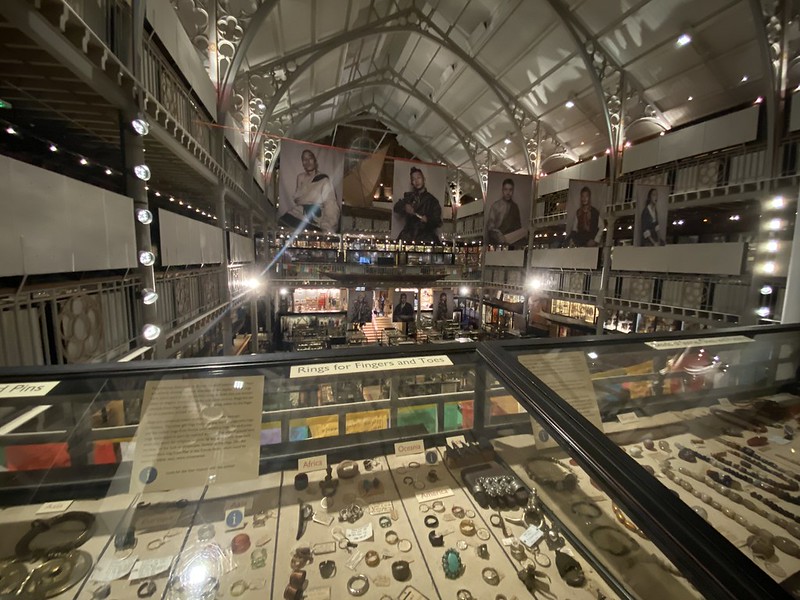
Pitt-Rivers Museum in Oxford, one of my favourite museums for its eclectic mix of artefacts all over the world, and the overwhelming view you get when you first walk in.
This is a wonderful place for a geographer to lose themselves.
In 1926, Myres was also President of the Folklore Society.
From one description of him:
Myres will perhaps be best known to posterity for his many contributions to the history of the ancient Greeks, their origins, distribution and culture. But the keynote of all his studies and writings was his broad outlook and versatility, his grasp of studies other than his own speciality, and his power to fit in all the many elements that make up a finished picture. ... Myres brought his knowledge of many subjects, both in the arts and sciences, to bear on his main problem -- the Greeks, ... and he was always seeking from others some item he might have overlooked, it was this sense that he might have missed some factor that kept him always so free of dogmatism and finality. [K.M., 1954: 541]
He had been involved with the Association for some time before becoming a President, and was involved with it for some time afterwards.
In 1920, he sent a number of lantern slides to the Association for their collection, which was growing rapidly at this time.
In 1925, he also featured in 'The Geographical Teacher' talking about 'Wayside Geography'. This is described as a 'broadcast address' as it was played on the BBC - I wonder if a copy exists anywhere.
He says in this piece:
"like any other science.... geography is simply a convenient name for a particular way of observing what goes on in [the] world"
He also finds opportunity in the every day:

In 1926, a longer version of this piece appeared in 'The Geographical Teacher', developing his ideas further, and worth a read if you have a subscription to 'Geography' and can access the archive via JSTOR.
In this expanded version, he mentions more examples of geography's power to describe and explain the world.
His Presidential Address was on the theme of Ethnology.

In 1926, he was thanked for a gift to the Association of over 700 slides, with notes.
“EDITORIAL.” The Geographical Teacher, vol. 13, no. 2, 1925, pp. 87–89. JSTOR, www.jstor.org/stable/40554985.
He was knighted in 1943.
 Image credit:
Sir John Linton Myres
by Walter Stoneman
bromide print, 1923
NPG x162242© National Portrait Gallery, London
Image credit:
Sir John Linton Myres
by Walter Stoneman
bromide print, 1923
NPG x162242© National Portrait Gallery, London
National Dictionary of Biography entry reads...
He founded no school. In his lifetime he saw classical archaeology grow from a dilettante study to a discipline which has much to contribute to all departments of classical scholarship.
His part in this development was to show how historian, archaeologist, anthropologist, and geographer should combine their skills in the study of antiquity.
His obituary, written by H. J. Fleure, was published in 'Geography' in 1954, and outlined his contributions to the subject in a long and varied career.
 References
https://en.wikipedia.org/wiki/John_Myres
I have edited this entry to add the fact that Myres was the President of the GA, as I have done with each President as I have come to them.
http://england.prm.ox.ac.uk/englishness-John-Linton-Myres.html
References
https://en.wikipedia.org/wiki/John_Myres
I have edited this entry to add the fact that Myres was the President of the GA, as I have done with each President as I have come to them.
http://england.prm.ox.ac.uk/englishness-John-Linton-Myres.html - Pitt Rivers Museum connections
https://www.encyclopedia.com/social-sciences/applied-and-social-sciences-magazines/myres-john-linton
Myres, J. Linton. “Geography and the Classics.” The Geographical Teacher, vol. 10, no. 5, 1920, pp. 236–238. JSTOR, www.jstor.org/stable/40555132.
Myres, John L. 1925 'Presidential Address: The methods of magic and science' Folklore, Vol. 36, No. 1 (Mar. 31, 1925), pp. 15-47
Myres, John L. 1926 'Presidential Address: Folkmemory' Folklore, Vol. 37, No. 1 (Mar. 31, 1926), pp. 12-34
Myres, J. L. “WAYSIDE GEOGRAPHY.” The Geographical Teacher, vol. 13, no. 1, 1925, pp. 65–66. JSTOR, www.jstor.org/stable/40556448.
Myres, J. L. “WAYSIDE GEOGRAPHY.” The Geographical Teacher, vol. 13, no. 4, 1926, pp. 285–295. JSTOR, www.jstor.org/stable/40556130.
Myres, John L. “A GEOGRAPHICAL VIEW OF THE HISTORICAL METHOD IN ETHNOLOGY.” The Geographical Teacher, vol. 13, no. 1, 1925, pp. 9–29. JSTOR, www.jstor.org/stable/40556436
Fleure, H. J. “OBITUARY: Sir John Linton Myres.” Geography, vol. 39, no. 2, 1954, pp. 128–128. JSTOR,
www.jstor.org/stable/40564578
If you know anything about him, please get in touch.
Here's a picture of mine of part of the Pitt Rivers Museum.
'The Pitt Rivers is packed beautifully, and practically to the ceiling with the most wonderful array of ethnographic objects, all soothingly lit and artistically arranged.'
Bill Bryson, The Road to Little Dribbling

Image: Alan Parkinson, shared under CC license.
Update - late July 2019
It is described as "long continued, intimate and unsparing help... especially valuable in some past times of some difficulty"
In 1928, he was elected as the President of the Royal Anthropological Institute and the Presidency of Section E. (Geography) of the British Association for the Advancement of Science.
Fleure, H. J. “ANNUAL REPORT.” Geography, vol. 14, no. 4, 1928, pp. 338–341. JSTOR, www.jstor.org/stable/40558279
Update - early August 2019
Found a reference to his work and photography
in this blog. It also said that he had a brother with an almost identical name, but doesn't say what that was. From the
Oxford Archaeology blog.
Myres is shown here in his white hat that he apparently wore, in a lantern slide, which is relevant of course...
 A nice piece by Alice Jaspars.
Image from Facebook of Myres wearing his white hat...

Update October 2019
Visited the museum as part of a visit which also involved meeting the Halford Mackinder Professor of Geography: Danny Dorling.

It remains an astonishing mix of objects, artefacts and scholarship.
Some of them were donated by Linton Myres
Myres' English collections given to the Pitt Rivers Museum
Myres' donation of English objects were few:
1934.37.1-3 3 Percussion Tower muskets, dated 1856, 1858 and 1862. ENGLISH.
1942.1.422-3 2 tallies, records of vegetables planted delivered by donor’s gardeners, Richard Smith, at the Copse, Hinksey Hill. V. File.
In the museum files there is a letter from John Linton Myres to Henry Balfour dated 27 August, 1935:
'The enclosed records were made about five years ago by my gardener at the Copse-Hinksey Hill, for vegetables delivered to the kitchen. His name is Richard Smith; he was about 75 years of age then; practically illiterate, though he recognized & distinguished unfailingly any packets of seed with printed labels that I gave him. He was very shy about these lists, and usually destroyed them; but these two we secured. They were always in this long tally-like form. The different arrangements of dots stood for different vegetables, but we only ascertained the meaning of a few (marked in ink) by comparing with the supplies received on each occasion. I see that I have put a note, at the time of collection, on the back of them.'
1946.10.55 Box containing experimental flakes of glass to illustrate the flaking-angle of 'eoliths' - made by Walter Charles Brice in 1941
[Bequest after his death] 1959.4.4-9 A set of six groups of Chinese scenes hand-painted in glass. These are an early form of lantern slide, and belonged to the late Sir J.L. Myres.
Updated July 2022
A holiday photo with his wife in Greece
Described as a 'father of Cypriot archaeology' and also a Freemason.
In 1941, he read a paper at the GA Conference on Greece.
Updated August 2023
Some small tweaks and changes.




.jpg)