Showing posts with label Patrick Geddes. Show all posts

Wednesday, 17 July 2024

Dudley Stamp - a memorial volume #1

Another discovery while following a few leads.

It's a memorial volume to Professor Dudley Stamp.

Can be borrowed from the Internet Archive.

Image: Dudley and Elsa Stamp

It was published in 1968 by the Institute of British Geographers.

The contents are a Who's Who of prominent geographers at the time, 

The first section of the book was written by another former GA President: Robert Ogilvie Buchanan.

He talks about his first encounter with Dudley Stamp.

It talks about his time at the Geographical Association:

More to come in future posts.

Monday, 15 June 2020

Geddes and Le Play

Updated April 2021


The Le Play Society has been mentioned in quite a few posts on the blog so far.
It was linked with the work of someone else who has been mentioned: Patrick Geddes.
Le Play was actually named after a French sociologist.
Patrick Geddes influenced, and helped to train several GA Presidents, and also present day geographers remain intrigued by his work.


Sources:
https://en.wikipedia.org/wiki/Pierre_Guillaume_Fr%C3%A9d%C3%A9ric_le_Play

Beaver, S. H. “The Le Play Society and Field Work.” Geography, vol. 47, no. 3, 1962, pp. 225–240. JSTOR, www.jstor.org/stable/40565418. Accessed 3 May 2020.

Update April 2021
According to this piece in the GA journal 'The Geographical Teacher' (1921), Patrick Geddes was a GA Vice President... I wonder whether he may have become President.

“Editorial.” The Geographical Teacher, vol. 11, no. 2, 1921, pp. 3–5. JSTOR, www.jstor.org/stable/40555898. Accessed 11 Apr. 2021.

Find out more about him in this short film - plenty more to explore here.

Patrick Geddes - Renascence Man from Stephen Robinson on Vimeo.

Patrick Geddes was an amazing late Victorian polymath who had far reaching ideas about the environment and Man's place within it. I was commissioned by McManus Galleries, Dundee to film and direct a short documentary to accompany an exhibition about his professional life.

Friday, 22 May 2020

1966: Professor Stanley Henry Beaver

Last updated August 2023

Professor Stanley Henry Beaver was an academic geographer, who was particularly associated with the LSE and Keele University, as well as being a great supporter of the work of the GA.

A prolific author, he authored books on a wide range of topics, from Sand and Gravel, to more general human geographies of the world, and geomorphology.
He had a very long association with the GA, as did many Presidents of course, working with them for over 30 years before becoming President in a number of roles, and providing content for journals.
He was involved with L Dudley Stamp's Land Utilisation Survey, and co-authored many of the reports that came out of that survey in the 1930s and beyond.

He also became involved in the planning and delivery of the Annual Conference in 1933, after Dr. H J Wood stood down.
During the 1930s, the GA Conference actually moved around a lot more than it had previously, where it was mostly held at the LSE. The 1930s saw it in cities including Liverpool, Glasgow, Nottingham and Sheffield. In 1932, the conference was even planned to be overseas in Heidelburg, but political and currency problems meant it had to be cancelled.

He had an association with the RGS (as many other GA Presidents have) and the IBG.

When he left the LSE he was succeeded by Michael Wise: another former GA President.

He also co-wrote a classic book with another GA President, L Dudley Stamp called 'The British Isles' as part of the 'Regional Geography' series.

He was born in London in 1907, and went to UCL where he graduated with first class honours in Geography in 1928. He completed his Diploma in Education in 1929, and according to an obituary published in the Transactions of the IBG, was influenced by L. W. Lyde, who apparently regarded geography as:
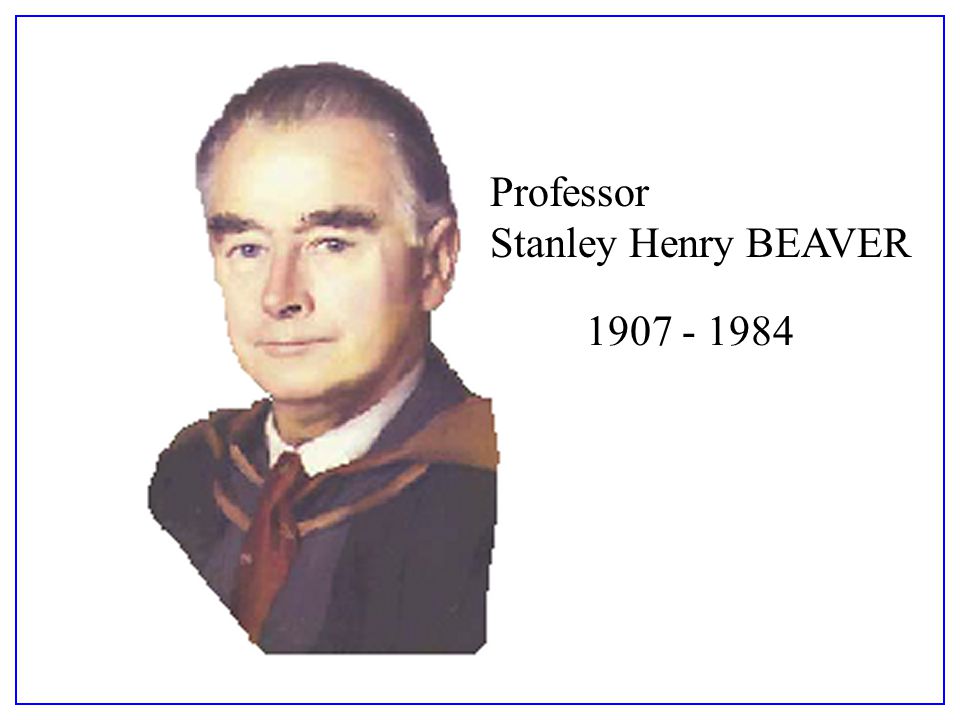
Image result for Professor Stanley Henry Beaver
"a body of knowledge coupled with an attitude of mind". 

He worked at the LSE between 1929 and 1950,  along with L Dudley Stamp

For some time, I couldn't find a contemporary image of Stanley Beaver, but was fortunate to receive one from Dr. Philip Kivell which can be seen at the top of the blog post.

In 1962, he had a piece published in 'Geography' on the Le Play Society and their contribution to fieldwork.

By this time, he was Head of the Geography department at the University of Keele. He stayed at Keele until his retirement in 1974 when he became Emeritus Professor.


In it, he references the work of Patrick Geddes, who had A. J. Herbertson as his assistant.


I am grateful to Dr. Peter Knight for helping me get in touch with Dr. Philip Kivell, who very kindly gave me a range of additional details on Professor Beaver's career and personal life. 
What follows was provided very kindly by Dr. Kivell.

S.H.BEAVER 1907-1984
Stanley Henry Beaver was born in Willesden, North London in August 1907. He graduated from University College London in 1928 with first class honours in Geography having already been awarded the Morris Prize and a University Scholarship in Geology. His first academic post was at the London School of Economics, where a very productive period resulted in appointment as Ernest Cassel Reader in 1946. His major work at this time, together with L Dudley Stamp was “The British Isles: a geographic and economic survey” which went though many editions before and after the war and provided a geographical grounding for  many thousands of students. 
During the war he worked for Naval Intelligence and used his geographical training to produce a number of regional handbooks. 
He was appointed as the founding professor of Geography at the new University College of North Staffordshire, subsequently Keele University, in 1950. 
Here he built up the first new post- war Geography Department in the country, including being closely involved in the physical design of the building. 
This included finding a home for millions of RAF air photographs taken over Europe during the war, and the establishment of a meteorological station on the campus.
Beaver could fairly be described as a traditional geographer, a product of an age that largely pre-dated the increasing specialization that reshaped the discipline from the 1960s. 
Having said that, his interests and skills were enormously diverse.  Most obviously he was a Human Geographer concerned with economic and regional matters, but his interests also ranged widely over transport geography, land use and dereliction and he was equally well informed about climate, meteorology, and mineral extraction. He was a practical academic, always interested in how environments and human processes worked and in this context he helped enormously to put “The Potteries” region on the map of public and academic awareness.
He was a superb and well organised teacher and was always in demand as a guest speaker by organisations across the country. From a student point of view he was extremely well respected but perhaps not the most approachable teacher. He belonged to an era when staff- student relations were more formal and respectful so the informality and student politics of the 1960s and 70s did not always sit easily with him. 
He could appear austere and remote but those who experienced his excellent field excursions soon saw a more relaxed side of him and were perhaps party to his dry sense of humour, his love of puns and his stock of limericks. At heart he was kind and immensely supportive to his staff and colleagues.
Apart from his teaching and research Beaver played a very active role in numerous groups and committees. Some of these were tied up with the University and local region, but others were national or international.  For many years he chaired Keele University Grounds Committee, responsible for the largest, and some would say, most attractive university campus in the country. It was not unknown for him to open his office window to berate students who were walking on the grass. 
He was President of the Geographical Association, active in the RGS and in the founding of the IBG, the IGU and the Anglo-Polish seminars. 
As Chair of the Geography Board of the CNAA he played a major role in promoting the new Polytechnic sector. Amongst all of this he found time to translate several important French texts into English.
During his quarter century at Keele  Stanley lived on the campus with his wife Elsie, who also worked as curator in the departmental map library, and four children. He enjoyed his large garden which he said (tongue in cheek) lay astride the watersheds between the Trent, Severn and Weaver catchments. One of his enduring passions had been steam railways, about which he was enormously knowledgeable. When the locomotive Keele Hall was withdrawn from service in 1963 Stanley Beaver bought the nameplate and displayed it proudly in his new department. On numerous overseas travels he would manage to arrange a trip on the footplate of whatever local steam locomotive took his fancy.
Upon retirement he and Elsie bought a large house in Eccleshall , a few miles from the campus, where he continued to garden, to enjoy his stamp collection and to continue his involvement in local Staffordshire organisations, especially the CPRE. He and Elsie endowed separate funds for student prizes and for fieldwork in the local area. 
Stanley Beaver was undoubtably one of the great geographers of his generation.
Professor Beaver died in 1984.

References
http://worldcat.org/identities/lccn-n50006237/

Obituary: “Stanley Henry Beaver, 1907-1984.” Transactions of the Institute of British Geographers, vol. 10, no. 4, 1985, pp. 504–506. JSTOR, www.jstor.org/stable/621896

Beaver, S. H. “The Le Play Society and Field Work.” Geography, vol. 47, no. 3, 1962, pp. 225–240. JSTOR, www.jstor.org/stable/40565418

British Geography 1918-1945, Edited by Robert.W Steel - published in 1987.
Chapter 12 was by J A Patmore, where he gave a personal perspective on the period.

Article in Geography in 1978
BEAVER, S. (1978). Some Observations on the Climate and Weather of New Zealand. Geography, 63(1), 14-22. Retrieved August 25, 2020, from http://www.jstor.org/stable/4056883
Patmore describes Beaver in this chapter.
A chapter in this book is here:
https://books.google.co.uk/books?id=9NSDx4DxfVcC&lpg=PA76&ots=uk5vMrcPG4&dq=stanley%20henry%20beaver%20geographer&pg=PA76#v=onepage&q&f=false

RGS Archives: http://discovery.nationalarchives.gov.uk/details/c/F46114 - I won't be able to visit the archive for a while, but there are quite a lot of papers

Updated - May 2020

A few updates to add following the posting.

There was a connection revealed between Professor Beaver and another former GA President who will have his own entry in due course (sometime in 2021) Bob Digby.
Bob told me that:


Bob apparently spent the £25 in the Keele University bookshop, buying geography textbooks from the time.

I also discovered another bit of information on Professor Beaver, from when he was a student at UCL in the 1920s. He was taught by Lionel William Lyde, another high profile Geographer from the early part of the 20th century.

His wife Elsie Rogers was also a student at UCL, and her memories of Lyde's teaching were also featured in the same document.


Taken from UCL Geography Department Archives.

Keele University offers an Elsie Beaver Prize for the best undergraduate dissertation by final year student involving fieldwork in physical geography, so the connection to Beaver continues.
It seems that she worked in the Map Library at the University as Map Curator. 


Beaver was also taught by another former GA President: Edmund Garwood. More connections...

Source:
https://books.google.co.uk/books?id=7BQSBwAAQBAJ&lpg=PA16&ots=qyoQUQmILd&dq=lyde%20geography%20definition&pg=PA8#v=onepage&q&f=false
- this link is to one of the many Biogeographical Studies, which are 'proper' versions of what I'm doing on this blog.

I also found his own entry, after all that, in the Biogeographical Studies series.


This included an image of him, and also details of his links with the GA, as well as a lot more detail.

Beaver was Honorary conference organiser from 1934-1949 and also declared an intention to visit every branch in Britain while President - something I hoped to do, but didn't quite manage it.


https://books.google.co.uk/books?id=R-48DwAAQBAJ&lpg=PA130&ots=vx3Y5ASsYg&dq=lionel%20lyde%20UCL&pg=PA129#v=onepage&q=lionel%20lyde%20UCL&f=false 

As always, if you have further information relating to this President please get in touch. 

Thanks to Dr. Philip Kivell for the image of Professor Beaver used at the top of the blog and substantive text later on.
Thanks to Dr. Peter Knight for his assistance as well.

Updated March 2023

Mentioned on first page of J B Priestley's 'English Journey'.

Updated August 2023


This flagged up his involvement with Section E of the BAAS, which I have been investigating over the last few days and have found plenty of details in the Transactions of the IBG and elsewhere that show Beaver's substantial involvement in discussions around geography in schools and universities. 


GA Obituary

Rodgers, H. B. “The Geographical Association.” Geography, vol. 70, no. 1, 1985, pp. 77–80. JSTOR, http://www.jstor.org/stable/40571501. Accessed 24 Aug. 2023. 

Wednesday, 20 May 2020

Fanny Herbertson

Updated August 2022

Sometimes (but not always) remembered in the telling of A J Herbertson's tremendous contribution to the GA was that of his wife Fanny. Frances Dorothea Herbertson is described below:


Her story, and those of other female geographers are told in this book here.

She was a teacher herself, at Cheltenham Ladies College, and there is also a connection with Patrick Geddes, who will also be featured on the blog in a future post.
There is a link to Robert Neal Rudmose Brown, who featured recently on the blog.
See the A J Herbertson post on the blog for more on the work that he completed with his wife, including jointly authored books.


Source
https://books.google.co.uk/books?id=p_xfuY8CJ48C&lpg=PT115&ots=xln_U09sEO&dq=%22marguerita%20oughton%22%20sheffield&pg=PT115#v=onepage&q&f=false


Updated August 2022

A Chronology of Fanny Herbertson 


Sunday, 10 May 2020

Robert Neal Rudmose Brown


I came across this geographer while researching Marguerita Oughton, who was a stalwart of the GA for many years, and retired in 1965. 'Ruddy' Brown or RB is described as an 'explorer' geographer. He fell out with former GA President Percy Maude Roxby over his thoughts on China.
His father was a prominent Geographer of the time, who went on expeditions to Spitsbergen and wrote popular books.
Rudmose Brown also worked as an assistant to another person who has reappeared several times: Patrick Geddes.

He wrote about the influence of Geddes and Herbertson in a paper in Geography in 1948, which I missed at the time of going through the 1940s.

According to the link below, he also raised funds for an expedition to Antarctica. It is worth reading his Herbertson Memorial Lecture from 1948 which is referenced at the end.

Updated August 2023
Source above:

The section on Rudmose Brown references a great many GA Presidents, plus Patrick Geddes - who was a GA Vice President.

A nice quote from J L Myres.

Source: Robert Neal Rudmose Brown - Delivered to geographers at the University of Sheffield
Scottish Geographical Magazine (Vol 30) 1914 p.467-79

Wednesday, 29 April 2020

Patrick Geddes on 'Geography' and the specialist

From the Herbertson Memorial Lecture of 1948, given by Robert Neal Rudmose Brown.


Source:
Brown, R. N. Rudmose. “SCOTLAND AND SOME TRENDS IN GEOGRAPHY: JOHN MURRAY, PATRICK GEDDES and ANDREW HERBERTSON.” Geography, vol. 33, no. 3, 1948, pp. 107–120. JSTOR, www.jstor.org/stable/40564415. Accessed 29 Apr. 2020.

Wednesday, 25 September 2019

1937: Professor Leslie Patrick Abercrombie (later Sir)

Sir (Leslie) Patrick Abercrombie - NPG x82059.jpg
Last updated June 2024

Patrick Abercrombie was a major person in the development of town planning, and was another of the Presidents who were chosen because of their public profile, rather than a connection with geography teaching per se.
I remember learning about his work in a module on planning which formed part of my degree in the early 1980s.
His name has since cropped up with respect to BAAS Section E and links with Sir Peter Hall, who is referenced quite a bit on the blog.  

He was born in Cheshire, and studied at Liverpool School of Architecture.

His work's legacy persists today and is still influential in discussions around town planning.

When he became GA President, the Second World War was approaching, but there was still a lot of change occurring in the British landscape.

Following the Second World War, Abercrombie became a leading person in the rebuilding of London and other places. This was also a time when planning was a big focus of the BAAS Section E.

His work led to the New Towns Act which has left a legacy of cities across the UK, and work on other cities which have been influenced by the movement, spreading worldwide.


From his Wikipedia page (shared under CC license)

Sir Patrick trained as an architect before becoming the Professor of Civic Design at the University of Liverpool School of Architecture in 1915, and later Professor of Town Planning at University College London. 

Afterwards, he made award-winning designs for Dublin city centre and was involved in the replanning of several other cities, including Hull.

He was also closely involved in the founding of the Council for the Preservation of Rural England (CPRE). After its formation in December 1926, he served as its Honorary Secretary. This is yet another important institution with a link to a GA President.

When Abercrombie became GA President, he had not yet completed his most famous work, which was yet to come after the Second World War.

His Presidential Address was entitled 'Geography, the basis of Planning'.

ABERCROMBIE, PATRICK. “GEOGRAPHY, THE BASIS OF PLANNING.” Geography, vol. 23, no. 1, 1938, pp. 1–8. JSTOR, http://www.jstor.org/stable/40560522. Accessed 24 Aug. 2023.

Duncan Hawley (and other geologists) need to look away from this extract.


He championed the idea of a Green Belt around London, and contributed to the Royal Commission on the Distribution of the Industrial Population, the report of which (Barlow Report) appeared in 1940. Green Belts are very much in the news in the summer of 2023 in terms of their suggested impact on new housing which is needed.

He is perhaps best known for the post-Second World War replanning of London. He created the County of London Plan (1943) and the Greater London Plan (1944) which are commonly referred to as the Abercrombie Plan. 

I've seen the plan / map referred to as the potato map.

He appears in the film The Proud City presenting his plan to the public - a rare film of a GA President talking:

The Proud City. Patrick Abercrombie from Planum. The Journal of Urbanism on Vimeo.


In 1945 he published A Plan for the City & County of Kingston upon Hull, with the assistance of Sir Edwin Lutyens. Lutyens had died the year before publication whilst much of the plan was being finalised, and the plan was ultimately rejected by the Councillors of Hull.

From the Abercrombie Plan came the New Towns movement which included the building of Harlow and Crawley. He produced the Clyde Valley Regional Plan in 1946 with Robert H Matthews that proposed the new towns of East Kilbride and Cumbernauld.

During the postwar years, Sir Patrick was commissioned by the British government to redesign Hong Kong.
In 1956 he was also commissioned by Haile Selassie to draw up plans for the capital of Ethiopia, Addis Ababa.

Patrick Abercrombie was Knighted in 1945.  In 1948 he became the first president of the newly formed group the International Union of Architects, or the UIA (Union Internationale des Architectes). The group now annually awards the Sir Patrick Abercrombie Prize, for excellence in town planning. In 1950 he received the AIA Gold Medal. The University of Liverpool's Department of Civic Design also continues to award an Abercrombie Prize annually to its top-performing student.

He died in 1957.

A Blue Plaque has been erected at a house formerly occupied by Patrick Abercrombie (lived there 1915-1935), in Oxton, Merseyside. 

References
Wikipedia: https://en.wikipedia.org/wiki/Patrick_Abercrombie

Source of image - Creative Commons

I amended the entry to add his GA Presidency - something I have done for each GA President who has a Wikipedia page.

Presidential Address: https://www.jstor.org/stable/40560522?seq=1#page_scan_tab_contents

David Matless piece: Matless, David. “Appropriate Geography: Patrick Abercrombie and the Energy of the World.” Journal of Design History, vol. 6, no. 3, 1993, pp. 167–178. JSTOR, www.jstor.org/stable/1316006.

https://www.ft.com/content/97afa1b2-44a3-11e4-ab0c-00144feabdc0

https://www.theguardian.com/uk-news/davehillblog/2014/mar/22/london-county-plan-abercrombie-forshaw

https://www.oxfordreference.com/view/10.1093/oi/authority.20110803095343737

Update (late September 2019)
Thoughts on Abercrombie's legacy from Brendan Conway

Update (October 2019)
Image result for jenkins history londonAbercrombie's legacy is also discussed in the new Short History of London by Simon Jenkins - a current read of mine.
The author is not a fan of the period where a lot of the historical streets of London were replaced, buildings removed, and threats to other buildings such as St. Pancras, in the period after the Second World War.
Abercrombie talked about London's past as a time of 'obsolescence, bad and unsuitable housing, uncorrelated road systems and inequality in the distribution of open spaces'.

I have a copy of a book which features the plan. A green belt was proposed to stop the expansion of the city, and there would be up to five 'ringways' to take traffic around the city centre.
People would be moved out of the city to new towns to take the pressure of the centre. The 1947 Town and Country Planning Act gave Abercrombie the power to change the lives of the 7 million inhabitants of the city, but it met opposition from the realities of a city which had survived the Blitz and needed to be rebuilt and given a new energy.

Jenkins' books is well worth reading.

In G. R. Crone's chronology of Geography in the 20th Century, there is a brief mention of Abercrombie's Presidential address.


Reference
Crone, G. R. “British Geography in the Twentieth Century.” The Geographical Journal, vol. 130, no. 2, 1964, pp. 197–220. JSTOR, www.jstor.org/stable/1794582.

Update
A video describing the plan.


 And a dramatised film describing the rebuilding of Plymouth based on Abercrombie's planning after the war.


Updated November 2020

In November 2019, Abercrombie got an English Heritage blue plaque unveiled at his house in his honour. Here's the ceremony...


Updated August 2021
A plan for a future Dublin - from 1922

Updated July 2022

I'm adding in additional perspectives on the work of Presidents and the people themselves as I find them, particularly where they may be problematic and relate to the current need to decolonise the subject itself but also revisit what are accepted narratives.
This thread is an interesting one with respect to the reasoning behind some of Abercrombie's planning decisions - this is of course a great responsibility.


Updated August 2023


Abercrombie met Patrick Geddes... another person linked with the GA...


Abercrombie was apparently influenced by Feng Shui

Matless, David. “Appropriate Geography: Patrick Abercrombie and the Energy of the World.” Journal of Design History, vol. 6, no. 3, 1993, pp. 167–78. JSTOR, http://www.jstor.org/stable/1316006. Accessed 24 Aug. 2023.

A piece in Nature from 1938 by S H Beaver (another former GA President to be...)

THE Geographical Association's annual conference usually has a theme corresponding to the interests of its president for the time being, and since in its choice of presidents the Association does not confine itself to academic geographers, considerable service to the subject is often done by this importation of a new viewpoint. This year the keynote of the Conference held at the London School of Economics on January 4–6 was the part that geography can play in planning. The presidential address, delivered by Prof. Patrick Abercrombie, professor of town planning at University College, London, was entitled “Geography, the Basis of Planning” ; and a symposium on town and rural planning was the principal individual item in the programme. To a certain extent these items in the Conference may be considered as corollary to the important discussion on “Planning the Land of Britain”, which was held at the Nottingham meeting of the British Association, as reported in NATURE of November 6, 1937, p. 791.


On his work on the Green Belt


Updated June 2024

Plenty of Tweets shared by the @createstreets account....


This post talks about the Green Belt as being 'The curse of Patrick Abercrombie' 

Also a comment on his plans for Hong Kong.


Margaret Mackintosh RIP

Updated post. Sad news at the end of last week from colleagues who have organised the Charney Conference over the years of the passing of Ma...