Showing posts with label Examinations. Show all posts

Tuesday, 25 August 2020

1977: Professor Stan Gregory

Updated August 2023


“a major agent for change in how geography is practised here in the UK..."

From the eulogy at Professor Gregory's funeral by Ron Johnston, former Vice-Chancellor of the University of Essex


Stan Gregory was Professor of Geography at the University of Sheffield, and also active at other universities.
Professor Gregory's address was on 'The Role of Physical Geography', and his work in the area of climate change was an area he will also be remembered for.

From the Obituary page of the University of Sheffield:

Stan Gregory was born in London in 1926 and educated at the Polytechnic Secondary School on Regent Street. He acquired his initial knowledge of meteorology while serving in the Navy towards the end of the Second World War. He then obtained a first in geography at King's College London (1950), followed by an MA (1951) and a PhD (1952) at the University of Liverpool while working as an assistant lecturer.

Working at Liverpool until 1968, Professor Gregory later moved to the University of Sheffield, where he remained until retirement, as Professor of Geography (1968-88). He served as Dean of the Faculty of Social Sciences (1978-80) and a Pro Vice-Chancellor (1980-84), as well as taking visiting posts in Australia, Canada, India, Eastern Europe, Jamaica and a number of African countries.

A leading climatologist, Professor Gregory had a particular interest in the study of rainfall in subtropical and tropical regions and related issues of water resources. Yet he was probably better known as a leader of the "quantitative revolution" in geography.

He was linked with the IBG, which later merged with the RGS.

To influence researchers and universities, he co-founded the Study Group on Quantitative Methods within the Institute of British Geographers.
To make a similar impact in schools, he persuaded the Geographical Association to set up a Committee on Models and Quantitative Techniques in Teaching, and he became its first chair.

He also promoted the "revolution" though a landmark 1963 textbook.
“Few textbooks have changed the practice of geography,” said Sir Paul Curran, the Vice-Chancellor of City University London, “but Stan's ‘Statistical Methods and the Geographer’ was one of them.


A keen and intrepid traveller, Stan saw many features of the globe: some of the highest mountains, longest rivers, mightiest water falls, biggest and deepest lakes, and largest deserts. (a statement taken from the obituary)

Stan's GA Conference theme, and his lecture were both on the theme of Physical Geography.
Gregory, S. (1978). The Role of Physical Geography in the Curriculum. Geography, 63(4), 251-264. Retrieved August 25, 2020, from http://www.jstor.org/stable/40568997


Stan was an early advocate for the use of the statistical method, and later technology. He was asked to chair an important GA committee at a time of tension.


Source: Ron Johnston Bibliogeography piece - sample on Google Books:
https://books.google.co.uk/books?id=kVtwDwAAQBAJ&lpg=PA90&ots=AHT4_XIJ21&dq=Geographical%20ASsociation%20Package%20Exchange&pg=PA87#v=onepage&q=Geographical%20ASsociation%20Package%20Exchange&f=false

He worked with the JMB examining board


He received the Murchison Award from the RGS, and a medal named after Hugh Robert Mill (another former GA President) awarded by the Royal Meteorological Society.
I like this mention of him too:


Might be something to introduce to the GA conference.

Stan was made an Honorary Member of the GA (one of the highest honours of the Association) in 1991.

Since I wrote this original piece back in August 2019, a couple of significant new resources appeared.
There was an excellent description of Stan's life in the University of Sheffield's Facebook area.
Included an image of him teaching.


Source: https://www.facebook.com/notes/university-of-sheffield-alumni/the-story-of-stan-gregory/10155934590756548/

Stan sadly died in 2016.
He left some money to the University which funds postgraduate students.

References
Gregory, S. “The Role of Physical Geography in the Curriculum.” Geography, vol. 63, no. 4, 1978, pp. 251–264. JSTOR, JSTOR, www.jstor.org/stable/40568997

https://www.sheffield.ac.uk/geography/news/stan_gregory-1.573272\

Image source: https://www.sheffield.ac.uk/alumni/our_alumni/obituary-archive/stan-gregory-obituary

https://www.facebook.com/notes/university-of-sheffield-alumni/the-story-of-stan-gregory/10155934590756548/ - the story of Stan Gregory

Bibliographical Studies mention: https://books.google.co.uk/books?id=E-xwDwAAQBAJ&lpg=PA93&ots=yyywauK3MP&dq=stan%20gregory%20sheffield&pg=PA92#v=onepage&q=stan%20gregory%20sheffield&f=false 

Please pass on any further memories of Stan Gregory if you have them.

Updated August 26th 2020

Thanks to Norman Graves (who will feature in the next Presidential post) for sending me some memories of Stan:

"Stan Gregory and I were students in the Joint School of Geography which was then shared by Kings College and the LSE, though he did a straight Geography degree while I did a BSc (Econ) which actually included a course in statistics which proved useful during the quantitative revolution. 
Our paths crossed again in Liverpool when I joined the Education Department, while he was in the Geography Department headed by Professor Steele at that time."


Updated October 12th 2020
Many thanks also to Richard Daugherty for sending me his own memories of Stan Gregory:

"Stan Gregory’s contribution to the Association’s development was exceptional. In addition to being its President in 1977/78 he also served terms as Hon Secretary and Trustee (twice). From his appointment as Secretary in 1968 to his final year as Trustee in 1990 that added up to a total of fifteen years contributing to the Association in those key voluntary roles.

Alice Garnett having negotiated the move of GA HQ from Manchester to Sheffield it was Stan Gregory who followed her by maintaining the GA’s links with the Geography Department of Sheffield University. Colleagues of his, including Bryan Coates and Malcolm Lewis, would also serve terms as officers of the Association. The debt which the Association owes to Sheffield’s Geography Department can best be summed up by pointing out that in every year from 1950 until 1992 at least one of the GA’s honorary officers was a member of Sheffield University's Geography Department’s academic staff.

My own memories of involvement in the Association’s activities are coloured by my first encounters with Stan. I had completed a degree at sleepy Oxford while the subject was changing rapidly elsewhere, not least at Cambridge. 

The 1960s ‘new geography’ had therefore passed me by as an undergraduate. A GA weekend course in Sheffield, led by Stan Gregory, during my first year in school teaching offered a chance to find out more.

Stimulated by what I had learned there I wrote to the GA asking to be kept in touch with the work of its newly formed committee, chaired by Stan Gregory, on ‘models and quantitative techniques in geography teaching’. Much to my surprise I received a letter back from Stan inviting me to become a committee member. It was a measure of Stan’s skills with people that, though I was initially overawed by the ideas and energy of committee colleagues like Rex Walford, he soon made me feel that I had a contribution to make."

Update November 2020

Obituary in the Times Higher Education Supplement

A geographer who radically reformed the discipline has died

A leading climatologist, Professor Gregory had a particular interest in the study of rainfall in subtropical and tropical regions and related issues of water resources. Yet he was probably better known as a leader of the “quantitative revolution” in geography.

To influence researchers and universities, he co-founded the Study Group on Quantitative Methods within the Institute of British Geographers. To make a similar impact in schools, he persuaded the Geographical Association to set up a Committee on Models and Quantitative Techniques in Teaching, and he became its first chair. He also promoted the “revolution” though a landmark 1963 textbook.

In a eulogy at Professor Gregory’s funeral, Ron Johnston, former vice-chancellor of the University of Essex, recalled Professor Gregory as “a major agent for change in how geography was practised here in the UK” who was also a highly effective university administrator. 
His “quiet tact and great patience in negotiations” had proved great assets during a period of student unrest while he was pro vice-chancellor.

A keen and intrepid traveller, Professor Gregory recently celebrated his 90th birthday by visiting the site of the Palace of the Queen of Sheba in Oman. He died after a stroke on 8 April and is survived by his wife Helga, two daughters from an earlier marriage and three grandsons.

Update: 
December 2020
In 2003, Chris Kington asked a number of former Presidents what had sparked their passion for geography. He lent me the letters and Stan had sent a reply.
In it, he talks about being evacuated from London in the 1930s. He had been attending the Polytechnic Secondary School in the Polytechnic, Regent Street in London. At the time his total experience had been Central London, but he was then evacuated to Minehead in Somerset at the age of 13. He was a keen walker and remembers a walk over North Hull overlooking the town.
He says:
"The autumn colours of the trees, the bracken, the heather and beyond that the blue of the sea all wrapping around the town and the neighbouring fields and marshes. I suddenly realised that the world was a wonderful place!"
Many thanks to Chris Kington for the loan of the letters.
Updated August 2023

New on the University of Sheffield Alumni Facebook page - a story which had an input from his daughter after the original version presumably.

Some lovely family photos on there.

An interview with Peter Batey who was influenced by Stan.

Quantitative Geography piece.

A detailed piece by Ron Johnston in Biogeographical Studies.

He references Robert Ogilvie Buchanan (another former GA President) as one of the better lecturers he had.

Stanley Beaver (another former GA President) also said that Stan Gregory was one of his best students - lots of connections like this have emerged over the years I've been working on this.

He also won the Hugh Robert Mill award (another former GA President)

https://books.google.co.uk/books?id=E-xwDwAAQBAJ&pg=PA72&lpg=PA72&dq=%22stan+gregory%22+geography&source=bl&ots=yzBtfrH7NQ&sig=ACfU3U24IDs3BsoaDHJaSOCIMiHOMhCA9Q&hl=en&sa=X&ved=2ahUKEwjChay4kPGAAxVUh_0HHeLtBDg4FBDoAXoECBgQAw#v=onepage&q=%22stan%20gregory%22%20geography&f=false

Thursday, 2 July 2020

Fieldwork - OFQUAL consultation


“Fieldwork is the best and most immediate means of bringing the two aspects of the subject (i.e. a body of knowledge and a distinctive method of study) together in the experience of the pupil. Therefore, fieldwork is a necessary part of geographical education; it is not an optional extra”  

(Bailey, 1974)

Over the years I've been part of many consultations and responses to consultations from the GA and also in a personal capacity. 
Over the years the GA and other bodies have had to fight to keep aspects of the subject, indeed the whole subject itself, on the curriculum.
Many consultations receive a low number of responses.
This often plays to those who want to skew the result in a particular way by saying "look, there's no real opposition to this in the responses to the consultation".
OFQUAL has a consultation running until the 16th of July. TAKE PART!

This consultation is on the content and running of the 2021 Exams for GCSE, AS (which nobody really does anymore) and A levels. There are some suggested changes which are being consulted on.

Image

Here is the bit that is important for us as geographers.


A look at the annex shows that the History GCSEs have had their content slimmed down - sometimes losing quite a lot of content, but Geography has just had the fieldwork element removed.

If fieldwork goes, then there is a great possibility that it will be lost forever, and if we have "done without it" the expectation will be that we can continue to "do without it".

The wording could perhaps be adapted so that the requirement to carry out fieldwork "beyond the school gates" is removed - there are options for fieldwork on the school grounds, or in the immediate area, or using secondary data more substantially. Or remove the requirement for it to be assessed in quite the way that it is currently, or perhaps as an alternative to a part of the course, that those schools who had already carried out fieldwork could opt for.

It is very important that fieldwork is retained. Remove other course content to free up time but keep one of the key elements of geographical study, and one which so many other former and indeed present Geographical Association Presidents have championed and fought for in decades past.
From Geoffrey Hutchings, to Patrick Bailey, to Nick Lapthorn and Gill Miller (and others) the GA has led on a whole range of fieldwork projects. The GA has a stategic partnership with the GA, showing the value placed on fieldwork. August 2015-16 saw the Year of Fieldwork.
During the summer the 2nd edition of my new book on 'Fieldwork through Enquiry' - a 2nd edition of the popular book co-written with John Widdowson will be published.

Virtual experiences are not fieldwork...
Chris Durbin's quote remains important here: "virtual fieldwork is like a virtual pint of beer~....


Add your voice to keep fieldwork.
For ideas for local and school-based fieldwork check out the GA's Geography from Home section of the website.

This blogpost represents my personal views.
The Geographical Association is also responding to the consultation and recommending to other geography teachers that they do the same.
Here's Alan Kinder's view in the TES


Thursday, 23 January 2020

1955: Leonard Sydney Suggate

Last updated August 2023

Leonard Sydney Suggate, who became GA President in 1955 published several regional Geography books along with L Dudley Stamp.

The 1950s were interesting times for the GA in the post-war period, as with the years following the First World War, when many changes happened as a result of the recovery from war.

Suggate originally worked in the printing trade, but then studied psychology before taking the University of London's Teacher's Diploma in geography.

This led to him becoming a teacher, a fairly rare beast as we have seen so far with the blog. 
Few teachers become GA Presidents historically.

Suggate taught geography at Dorking High School, and later at St. Clement Danes Grammar School during the First World War (eventually retiring from there in 1949), which means he is one of a minority of people who had substantial experience of teaching geography before becoming President.

He took over the Presidency six years after retiring from what seems to have been an outstanding teaching career at a number of schools, and it is great to see that someone who was predominantly in the classroom for their career was able to step up to the role.

He was very much influenced by the 'new' geography of Halford MacKinder, and used these ideas in his teaching as well (although by now they were not as new as they once were), writing about them in his work.

He also attended lectures by Mackinder, Garwood, Lyde and Unstead - familiar names from this blog. The War also provided for him an opportunity to radically rethink school geography. This is great to see someone taking on the chance to hear the important people of the time, and factor those ideas into his practice - something which teachers of today do with some success, building on the evidence of research and taking inspiration from academic geographers and practitioners.

There are several contributions that Suggate made to geography teaching in the post-war period.
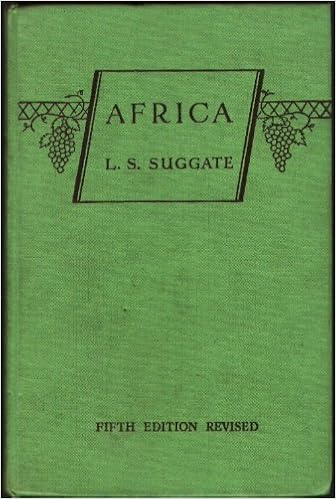
He wrote some of the first textbooks for the new analytical geography, such as 'Africa' - pictured to the right (one of the first school texts on the continent), and which ran to several editions.

He also campaigned for the use of maps and photos to be made available to candidates in school geography examinations, as well as greater use of visual aids in teaching.

He served concurrently on the Council of the RGS as well as the GA, and was elected a Fellow of the Royal Geographical Society in 1921. Another GA President to have a strong connection with the RGS.

He was also a Chief Examiner for the London General School Certificate - another GA President with  significant examining experience as well.
He served on the RGS Education Committee as well, which is of interest as another connection between the two organisations. The work of the RGS's Education Committee continues to be important, and I was involved in supporting the application of several representatives for RGS Council positions in the last few years.

Suggate attended the GA Conference every year apparently, "pipe in hand" - no smoking allowed these days of course.

He was also a Labour party councillor for Hendon.

In 1928, he started to make some changes at Clement Danes School.

When the school moved to a new site, Suggate created a special "Geography room" with a light table (which I remember from geography classrooms I sat in during the 1970s) and cases for equipment and showing artefacts.

I liked the story from his obituary, regarding his apparently indicipherable handwriting. A student asked what he had written at the bottom of their work, to which he replied "you must improve your handwriting, obviously...."

One of the projects that he started (along with another President Leonard Brooks was to develop a scheme where schools could "adopt" ships and send letters to their Captains. It was called the Ship Adoption Society. This has been featured in more detail in the entry for Leonard Brooks, as he mentioned it in his Presidential Address.

Also in 1955, he attended the 125th Anniversary dinner of the Royal Geographical Society, along with other former Presidents such as L Dudley Stamp and J A Steers.

His Presidential year's conference is also described here - in this Nature piece.

Suggate wrote a series of books, which went into several editions.
He described his Presidential election as "at once an exciting and sobering elevation", which I sympathised with.

His Presidential Address was on the theme of geography teaching in Grammar Schools, making it of particular relevance to his audience no doubt.


Two years after completing his GA Presidency, Suggate and his wife emigrated to New Zealand at the age of 67, to join their two sons. 
There, he was also (at that age) Secretary of the Second Triennial Conference of the New Zealand Geographical Association, and continued to write for books. A well deserved and long retirement was enjoyed.


He died in 1970 - another GA President to live to an old age (81) and with 60 years of service to the GA.

I am grateful to Fiona Hirst, Archivist at Clement Danes School for the wonderful image of Leonard from the school magazine at the top of this entry. She very kindly sent me a range of documents and other information to help add detail to what was previously quite a slight entry on the blog compared to some of the previous ones.

An obituary was published in 'Geography' in 1971, written by A D Nicholls, who was a long standing colleagues as well as also being a Former GA President by that time - he is yet to appear here.


References

No Wikipedia entry available. Perhaps a further extension of this project would be to create them for the missing GA Presidents.

Nicholls, A. D. “LEONARD S. SUGGATE, B.Sc., A.K.C. 1889-1970.” Geography, vol. 56, no. 2, 1971, pp. 152–153. JSTOR, www.jstor.org/stable/40567514.

https://archive.org/details/in.ernet.dli.2015.224015/page/n5 - one of Suggate's books

SUGGATE, L.S. Aspects of Geography Teaching in the Grammar School Geography 1956 41 1-14

https://www.questia.com/library/journal/1G1-78392752/oskar-h-k-spate-1911-2000 - a pupil of Suggate's remembers his teaching

“The 125th Anniversary Dinner.” The Geographical Journal, vol. 121, no. 3, 1955, pp. 392–404. JSTOR, www.jstor.org/stable/1790929.

Something in the IoE archives: https://archive.ioe.ac.uk/DServe/dserve.exe?dsqIni=Dserve.ini&dsqApp=Archive&dsqDb=Catalog&dsqCmd=Show.tcl&dsqSearch=(RefNo==%27IE/JUB/B/1%27)

R. J. Harrison Church. “Obituary: Leonard Sydney Suggate, BSC, AKC.” The Geographical Journal, vol. 137, no. 1, 1971, pp. 136–137. JSTOR, www.jstor.org/stable/1795429.
Africa Book: https://archive.org/details/in.ernet.dli.2015.227333

If anyone knows anything else about this President, please get in touch. This is a relatively brief entry.

Thanks to Fiona Hirst for the additional details and image from the school magazine 'The Dane'

Updated August 2023


Sunday, 7 July 2019

1922: Geography's position in Secondary schools

Geography has often had to fight for its place on the curriculum. Various GA Presidents have written eloquent and timely statements on the value of geography, and why anybody who leaves school without studying it cannot really call themselves educated.

This work has had to continue, and as we shall see later in the 1970s and 80s, Geography was threatened again and the GA played a major role in safeguarding its place on the curriculum.

In 1922, following lots of contact and lobbying of the Board of Education, along with other organisations and individuals, the Board of Education sanctioned geography courses to run in the upper forms of secondary schools.

This was the culmination of years of effort by GA Officers, and a reminder of the role that the GA has had in school Geography for well over a century.

Support those efforts by being a member of this subject-specific community of practice.

Margaret Mackintosh RIP

Updated post. Sad news at the end of last week from colleagues who have organised the Charney Conference over the years of the passing of Ma...