Showing posts with label Classicist. Show all posts

Thursday, 25 July 2019

1925: Professor John Nowell Linton Myres OBE FBA (later Sir)

Last updated August 2023

Professor John Linton Myres was an archaeologist and historical geographer, and was linked to the University of Oxford, as were many GA Presidents during the early decades of the 20th Century.

Several other presidents have also had a strong connection with both Archaeology and Historical geography.

Myres was connected with the Pitt-Rivers Museum in Oxford, one of my favourite museums for its eclectic mix of artefacts all over the world, and the overwhelming view you get when you first walk in. 

This is a wonderful place for a geographer to lose themselves.

In 1926, Myres was also President of the Folklore Society.

From one description of him:

Myres will perhaps be best known to posterity for his many contributions to the history of the ancient Greeks, their origins, distribution and culture. But the keynote of all his studies and writings was his broad outlook and versatility, his grasp of studies other than his own speciality, and his power to fit in all the many elements that make up a finished picture. ... Myres brought his knowledge of many subjects, both in the arts and sciences, to bear on his main problem -- the Greeks, ... and he was always seeking from others some item he might have overlooked, it was this sense that he might have missed some factor that kept him always so free of dogmatism and finality. [K.M., 1954: 541]

He had been involved with the Association for some time before becoming a President, and was involved with it for some time afterwards.
In 1920, he sent a number of lantern slides to the Association for their collection, which was growing rapidly at this time.

In 1925, he also featured in 'The Geographical Teacher' talking about 'Wayside Geography'. This is described as a 'broadcast address' as it was played on the BBC - I wonder if a copy exists anywhere. 
He says in this piece:

"like any other science.... geography is simply a convenient name for a particular way of observing what goes on in [the] world"

He also finds opportunity in the every day:


In 1926, a longer version of this piece appeared in 'The Geographical Teacher', developing his ideas further, and worth a read if you have a subscription to 'Geography' and can access the archive via JSTOR.

In this expanded version, he mentions more examples of geography's power to describe and explain the world.

His Presidential Address was on the theme of Ethnology.


In 1926, he was thanked for a gift to the Association of over 700 slides, with notes.
“EDITORIAL.” The Geographical Teacher, vol. 13, no. 2, 1925, pp. 87–89. JSTOR, www.jstor.org/stable/40554985.

He was knighted in 1943.


Image credit:
Sir John Linton Myres
by Walter Stoneman
bromide print, 1923
NPG x162242© National Portrait Gallery, London

National Dictionary of Biography entry reads...

He founded no school. In his lifetime he saw classical archaeology grow from a dilettante study to a discipline which has much to contribute to all departments of classical scholarship. 
His part in this development was to show how historian, archaeologist, anthropologist, and geographer should combine their skills in the study of antiquity.

His obituary, written by H. J. Fleure, was published in 'Geography' in 1954, and outlined his contributions to the subject in a long and varied career.


References
https://en.wikipedia.org/wiki/John_Myres

I have edited this entry to add the fact that Myres was the President of the GA, as I have done with each President as I have come to them.

http://england.prm.ox.ac.uk/englishness-John-Linton-Myres.html - Pitt Rivers Museum connections
https://www.encyclopedia.com/social-sciences/applied-and-social-sciences-magazines/myres-john-linton
Myres, J. Linton. “Geography and the Classics.” The Geographical Teacher, vol. 10, no. 5, 1920, pp. 236–238. JSTOR, www.jstor.org/stable/40555132.

Myres, John L. 1925 'Presidential Address: The methods of magic and science' Folklore, Vol. 36, No. 1 (Mar. 31, 1925), pp. 15-47

Myres, John L. 1926 'Presidential Address: Folkmemory' Folklore, Vol. 37, No. 1 (Mar. 31, 1926), pp. 12-34

Myres, J. L. “WAYSIDE GEOGRAPHY.” The Geographical Teacher, vol. 13, no. 1, 1925, pp. 65–66. JSTOR, www.jstor.org/stable/40556448.

Myres, J. L. “WAYSIDE GEOGRAPHY.” The Geographical Teacher, vol. 13, no. 4, 1926, pp. 285–295. JSTOR, www.jstor.org/stable/40556130.

Myres, John L. “A GEOGRAPHICAL VIEW OF THE HISTORICAL METHOD IN ETHNOLOGY.” The Geographical Teacher, vol. 13, no. 1, 1925, pp. 9–29. JSTOR, www.jstor.org/stable/40556436

Fleure, H. J. “OBITUARY: Sir John Linton Myres.” Geography, vol. 39, no. 2, 1954, pp. 128–128. JSTOR, www.jstor.org/stable/40564578

If you know anything about him, please get in touch.

Here's a picture of mine of part of the Pitt Rivers Museum.


'The Pitt Rivers is packed beautifully, and practically to the ceiling with the most wonderful array of ethnographic objects, all soothingly lit and artistically arranged.'
Bill Bryson, The Road to Little Dribbling


Image: Alan Parkinson, shared under CC license.

Update - late July 2019

Myres' continuing support of the Association was mentioned in the 1928 Annual Report.

It is described as "long continued, intimate and unsparing help... especially valuable in some past times of some difficulty"
In 1928, he was elected as the President of the Royal Anthropological Institute and the Presidency of Section E. (Geography) of the British Association for the Advancement of Science.

Fleure, H. J. “ANNUAL REPORT.” Geography, vol. 14, no. 4, 1928, pp. 338–341. JSTOR, www.jstor.org/stable/40558279

Update - early August 2019

Found a reference to his work and photography in this blog. It also said that he had a brother with an almost identical name, but doesn't say what that was. From the Oxford Archaeology blog.
Myres is shown here in his white hat that he apparently wore, in a lantern slide, which is relevant of course...

ad34428_185-scr

A nice piece by Alice Jaspars.

Image from Facebook of Myres wearing his white hat...


Update October 2019
Visited the museum as part of a visit which also involved meeting the Halford Mackinder Professor of Geography: Danny Dorling.
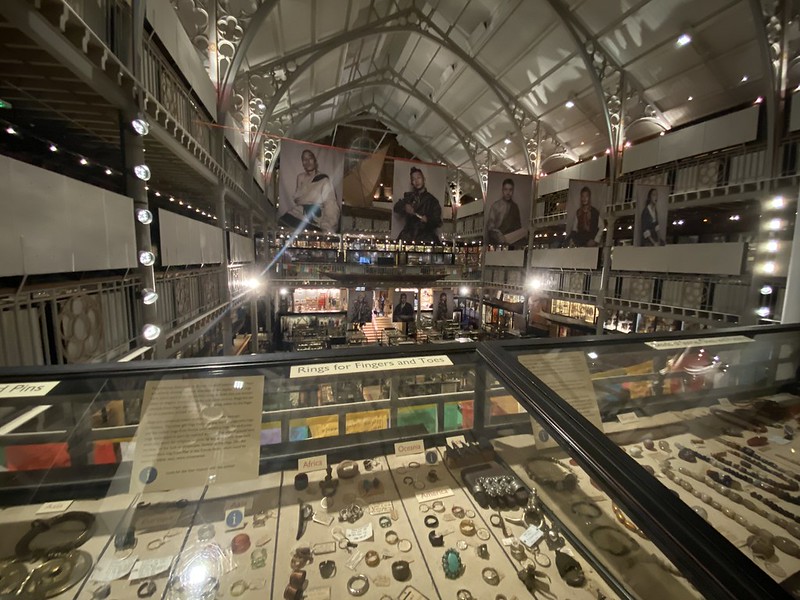

It remains an astonishing mix of objects, artefacts and scholarship.
Some of them were donated by Linton Myres

Myres' English collections given to the Pitt Rivers Museum
Myres' donation of English objects were few:
1934.37.1-3 3 Percussion Tower muskets, dated 1856, 1858 and 1862. ENGLISH.
1942.1.422-3 2 tallies, records of vegetables planted delivered by donor’s gardeners, Richard Smith, at the Copse, Hinksey Hill. V. File.

In the museum files there is a letter from John Linton Myres to Henry Balfour dated 27 August, 1935:

 'The enclosed records were made about five years ago by my gardener at the Copse-Hinksey Hill, for vegetables delivered to the kitchen. His name is Richard Smith; he was about 75 years of age then; practically illiterate, though he recognized & distinguished unfailingly any packets of seed with printed labels that I gave him. He was very shy about these lists, and usually destroyed them; but these two we secured. They were always in this long tally-like form. The different arrangements of dots stood for different vegetables, but we only ascertained the meaning of a few (marked in ink) by comparing with the supplies received on each occasion. I see that I have put a note, at the time of collection, on the back of them.'
 
1946.10.55 Box containing experimental flakes of glass to illustrate the flaking-angle of 'eoliths' - made by Walter Charles Brice in 1941
 
[Bequest after his death] 1959.4.4-9 A set of six groups of Chinese scenes hand-painted in glass. These are an early form of lantern slide, and belonged to the late Sir J.L. Myres.

Updated July 2022
A holiday photo with his wife in Greece


Described as a 'father of Cypriot archaeology' and also a Freemason.


In 1941, he read a paper at the GA Conference on Greece.


Updated August 2023
Some small tweaks and changes.


Monday, 1 July 2019

1921: Professor Gilbert Murray, LLD, FBA, MA, OM

Updated August 2023

“I could not give up Greek; but for the rest I seemed to have no choice. I saw what War was; I saw many of my best friends and pupils killed in the flower of youth; I saw the cruelties, the lapse into barbarism, and the ultimate poisoning of all human relations that followed from the Great War. I had to give what powers I possessed to the movement for making secure some peaceful life for mankind, not merely avoiding war, but preventing war by the formation of a Society of Nations.” 

Gilbert Murray, speaking at a dinner held on 13 February 1936 in honour of his 70th birthday.

Professor Gilbert Murray was an important figure in philosophy and classics, and Greek in particular, and from the biographies I have discovered, he had a remarkable life and varied career, although he was not particularly a geographer, and is well remembered even today as well as being honoured during his lifetime.

He was born in Australia, but was sent to study in the UK, with some time spent being educated at the Merchant Taylor's School.

As with several Presidents I have written about at this time, he didn't have an obvious connection with geography and education. He was another person involved in this period of change in the Association, when the plan was to bring in distinguished outsiders with geographic interests to strengthen the standing of the Association.

Murray was the Regius Professor of Greek at Oxford (Somerville College) from 1908 to 1936 (so was in post during his time at the GA), and also a Professor of Greek at Glasgow University. They have a Gilbert Murray Memorial Lecture which is held every three years.

He seems to have been quite supportive of female scholars.


His Presidential Address also had a 'Classical' feel to it.
It was called
Orbis Terrestris


Source: https://archive.org/details/geography11a12geoguoft/page/n33/mode/2up

This is an interesting address, which has very little actual 'geography' in it to begin with, but explores some ways in which the Earth was conceived of by early scholars.
He uses less than PC language about 'foreigners", although he says that some of our views on them comes from not really understanding the differences and the similarities between us.

"With increased knowledge of the world", he says, "we get to see the reasons for the differences of custom, and they cease to be so upsetting."

However, the next section is not quite as forgiving. "It is the same with physical characteristics. Europeans are often conscious of the smell of negroes and dislike negroes accordingly."
And then redeems himself again.
"But a very little anthropology teaches us that all human beings smell.... a Japanese waiting maid is apt to fall in a faint at the smell of a number of Europeans... When knowledge and understanding come in, the peculiar sense of horror connected with the unknown vanishes."

He continues by speculating on relations between countries which may be to come, referring to the League of Nations, and possible relationships between Africa and Europe with regards to "exploitation".
I came across this film of Murray speaking, on YouTube.

This is very early stuff.... Hilaire Belloc's clip on his post from 1915 is slightly earlier, but there is only audio of him.
Could this be the first of the GA Presidents for whom some video footage remains? I think it must be! 
Not sure when this was filmed, but obviously quite a long time ago, and when Gilbert Murray was older.


One of his lasting legacies is that he was an original and active member of the Oxford Committee for Famine Relief, founded in 1942, which later became Oxfam.

Another profoundly important GA Presidential contribution - no pressure then...

Order of Merit Dorothy Hodgkin (cropped).jpg
He was deeply affected by the First World War, and became one of the leading figures in promoting world peace through the League of Nations, as did the President who came after him (of which far more to come later)

He was a particular scholar of the poetry of Shelley.

He was awarded the French Order of Merit (OM) - pictured to the right... again, I'm not sure of any other Presidents who were similarly honoured.

I may need to go and visit this at some point. Any images of the memorial welcome.

Are any other GA Presidents similarly honoured in the place of their burial?

The inscription on the grave is translated as:

GILBERT MURRAY O.M. An example of true humanity, while he lived the letters of the ancient Greeks lived again, nor was there any reason to despair of the harmony of peoples. 1866 1957

References
https://wikivisually.com/wiki/Gilbert_Murray

https://gilbertmurraytrust.weebly.com/about-gilbert-murray.html - Gilbert Murray Trust

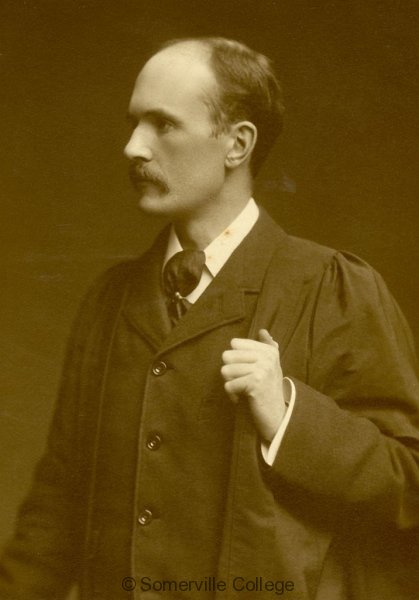
Somerville College: http://blogs.some.ox.ac.uk/archive/2011/09/22/gilbert-murray/ - source of the image, to which they hold the copyright - used here under Fair Use.
https://universitystory.gla.ac.uk/biography/?id=WH2276&type=P
 - Glasgow University

His papers are held at the Bodleian Library: http://www.bodley.ox.ac.uk/dept/scwmss/wmss/online/modern/murray/murray.html

GA Presidential Address:
“Orbis Terrestris.” The Geographical Teacher, vol. 11, no. 1, 1921, pp. 5–14. JSTOR, www.jstor.org/stable/41553245.

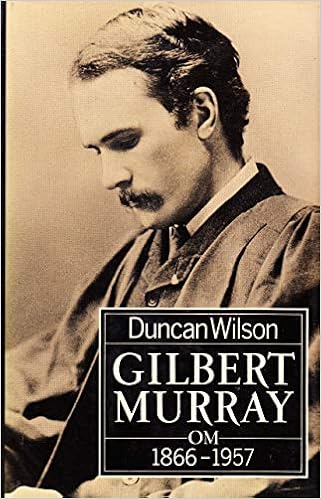
Biography of Gilbert Murray, written by Duncan Wilson


As always, if anyone has anything else to add about Murray's contributions to the GA, particularly during his time in office, get in touch.

Updated August 2023
A Somerville College link here:


An intriguing connection here with the Second World War and anti-Nazi activity.

And an even more interesting (perhaps) link here is to the formation of the charity Oxfam. This started as the Oxford Fund for Famine Relief, and Gilbert Murray was in the group that founded it, along with Vera Brittain and Edith Pye.


I looked at this in more detail:

On January 27, 1942, George Bell, the bishop of Chichester, spoke to the House of Lords in support of an appeal for Greece. Later that day the House of Commons announced that a shipment of wheat would be sent from Egypt, through the Allied blockade, and on to Greece. Within several weeks, regular shipments of supplies began to reach the devastated nation.

Writer Vera Brittain, who had been involved in humanitarian issues as well, believed that a relief campaign by pacifists Pacifism would not be taken seriously by the British parliament. She encouraged the development of an organization, which would convey a sense of seriousness and focus. Members of the Friends’ Service Council Friends’ Service Council[Friends Service Council](the permanent relief organization of the Quakers) met on April 22 to discuss forming a national famine relief committee; the planned organization was announced on May 29. Longtime Quaker activist Edith M. Pye was named the fledgling committee’s honorary secretary, and she worked to ensure the group’s success by securing supporters.

On October 5, the Oxford Committee for Famine Relief had its first meeting. 
Founding members included Bell and Gilbert Murray, professor of Greek at Oxford University, among many others. 

The committee’s initial objectives were to obtain information on food conditions in Greece and to promote food relief in other occupied countries. In December, London businessman Cecil Jackson-Cole was appointed the new honorary secretary of Oxfam. Jackson-Cole remained a driving force behind the committee for many years, and in 1947 he would help to open the world’s first permanent charity-run gift shop (operated by Oxfam). Situated in Oxfam’s main offices on Broad Street, the store was a drop-off location for donations. Profits from the sale of donated goods went directly to the organization to support its relief efforts.

So a GA President indirectly helped create the charity shop as we know it...


Source: https://wikisummaries.org/oxford-committee-for-famine-relief-is-founded/?utm_content=cmp-true

Margaret Mackintosh RIP

Updated post. Sad news at the end of last week from colleagues who have organised the Charney Conference over the years of the passing of Ma...